
Hungarian Prime Minister V. Orban said at a press conference on 21.12.2023 that Russia's military actions on the territory of Ukraine are "a military operation, as there has been no declaration of war between the two countries. When Russia declares war, then there will be war".
.png)
The validity of this statement was assessed by Igor Todorov, Doctor of Historical Sciences, Professor
Facts
1.
At present, states carrying out an armed invasion of another country avoid a formal declaration of war. This is done in order not to violate openly the principles and norms of International Humanitarian Law (IHL) adopted since the middle of the XX century [1, 2, 3]. Thus, the Geneva Convention of 1949 [1] and the UN General Assembly Resolution of December 14, 1974 [3] introduced a complete ban on the use of force against the territorial integrity or political independence of another state. Under such conditions, the fact of an official declaration of war by an aggressor state is tantamount to the recognition of such a state as a world criminal in violation of IHL, with all the legal consequences that follow [3, Article 5].
In this regard, states often use alternative terms in order not to formally recognize the state of war [4, 5]. For example, the Afghan war of 1979-1989 was officially called "Introduction of a limited contingent of Soviet troops into Afghanistan", the war in Georgia in 2008 - "Peace enforcement operation". The name "Special Military Operation" is a similar euphemism for Russia's invasion of Ukraine on February 24, 2022.
It should be taken into account that neither "military operation" nor "war" are legal terms. They do not have a strict definition in modern IHL. Instead of the word "war" the terms "international armed conflict" (if it is a war between states) [1, 2, 6, 7] or "act of aggression" [3] are used.
On the other hand, the legal instruments of International Humanitarian Law emphasize that its principles and norms apply irrespective of the declaration of war.
For example, the Geneva Convention of August 12, 1949 on the Protection of Civilian Persons in Time of War (Section I. General Provisions. Article 2) states [1]: "... the present Convention shall apply to all cases of declared war or of any other armed conflict which may arise between two or more of the High Contracting Parties, even if the state of war is not recognized by one of them. And in Resolution 3314 of December 14, 1974, adopted at the XXIX session of the UN General Assembly. Article 3 states [3]: " Any of the following acts, regardless of a declaration of war, shall... qualify as an act of aggression: (a) The invasion or attack by the armed forces of a State on the territory of another State, or any military occupation, however temporary, resulting from such invasion or attack, or any annexation by the use of force of the territory of another State or part thereof..."
Therefore, today, a formal declaration of war is not a prerequisite for having grounds to call a given armed conflict a war. In other words, a war may be declared or undeclared, but it does not cease to be a war. By the way, in the note of Nazi Germany of June 21, 1941, which de facto became a declaration of war against the USSR, military actions against the Soviet Union are called not a war, but "countermeasures" [13].
2.
Given the lack of a legal definition of war (as mentioned above), at present, diplomatic and legal practice in qualifying a particular armed conflict is guided by the so-called duck test ("if it looks like a duck, swims like a duck and quacks like a duck, it is a duck" [8, p. 7]). For this purpose, two main objective features that distinguish a war from a military operation are used: the scale of military operations and the degree of mobilization of the parties' resources [6, 7]:
- a war requires mobilization of all resources of the opposing sides and has a large scale in terms of the territory of military operations, losses of personnel and equipment, civilian casualties, environmental and humanitarian consequences;
- a military operation is limited in terms of the resources involved and has a localized character with minimal civilian casualties and limited environmental and humanitarian consequences.
The military confrontation between Russia and Ukraine is the largest armed conflict in Europe since World War II. By the end of 2023 [9-11]:
- the total length of the front line amounted to more than 3,000 km,
- military operations covered more than 240,000 sq. km of Ukrainian territory,
- both sides destroyed tens of thousands of military equipment, including aircraft, sea vessels, armored vehicles and artillery systems,
- total losses of personnel - hundreds of thousands of people,
- The number of civilian casualties is in the tens of thousands,
- more than 10 million people have become refugees and internally displaced persons in Ukraine,
- As a result of military actions, the dam of the Kakhov hydroelectric power station and one of the largest water reservoirs in Europe have been destroyed, the regular operation of Ukraine's nuclear power plants has been disrupted, including Europe's largest nuclear power plant, the Zaporizhzhya nuclear power plant, which poses a threat of radioactive contamination on a continental scale,
- the entire economies of Russia and Ukraine have been put on a war footing.
Thus, by all objective signs, the armed conflict between Russia and Ukraine clearly corresponds to the status of war, not a military operation. This was recognized by the UN General Assembly at the session ES11/1 in its resolution of March 2, 2022, indicating in the text that "... military operations of the Russian Federation on the sovereign territory of Ukraine are on a scale that the international community has not seen in Europe for decades, and that urgent action is needed to save this generation from the scourge of war" [12].
3.
The fact that the legal consequences and obligations of the parties to an armed conflict do not depend on how it is qualified by politicians and diplomats ("war" or "military operation") does not mean that such qualification is irrelevant. The use in public speeches of the name of a full-scale war between Russia and Ukraine as a "special military operation" creates in society a false idea of the local character of what is happening and actually promotes the interests of one of the parties (in this case - Russia).
Verdict

V. Orbán's assertion is not true. Under current international law, no formal declaration of war is required to recognize the status of war. In terms of its unprecedented scale, the armed conflict between Russia and Ukraine is unequivocally a war. The use in public space of the name of this conflict as a "special military operation" creates a false impression in society about the localization of what is happening and actually promotes the interests of Russia.
Sources of information
1. The Geneva Conventions of 12 August 1949
2. Protocols Additional to the Geneva Conventions of 12 August 1949.
3. Resolution 3314 on December 14, 1974, adopted at the XXIX session of the UN General Assembly. Definition of aggression.
4. I. Levontina, E. Shmeleva. Zetniki i netvoynyashki. What Special Military Russian has become. Carnegie Center Berlin. March 14, 2023. (in Russian)
5. Guy Faulconbridge. In Russia, the talk is of 'war' - even from Putin. June 8, 2023.
6. How is the term “Armed Conflict” defined in International Humanitarian Law? International Committee Of The Red Cross. Opinion Paper 2024.
7. B.Benson. The Evolution of the Army Doctrine for Success in the 21st century. Military Review. March-April 2012. P. 2—12.
8. Robin S. Davis. Who's Sitting on Your Nest Egg? Publ. by Bridgeway Books. 2007. 141 p.
9. Ukrainian refugee crisis. From Wikipedia.
10. Casualties of the Russo-Ukrainian War. From Wikipedia.
11. DeepStateMap project - a map of the war in Ukraine.
12. UN General Assembly Resolution ES-11/1 of March 2, 2022.
13. Note from the German Foreign Office dated June 21, 1941. Memorandum.
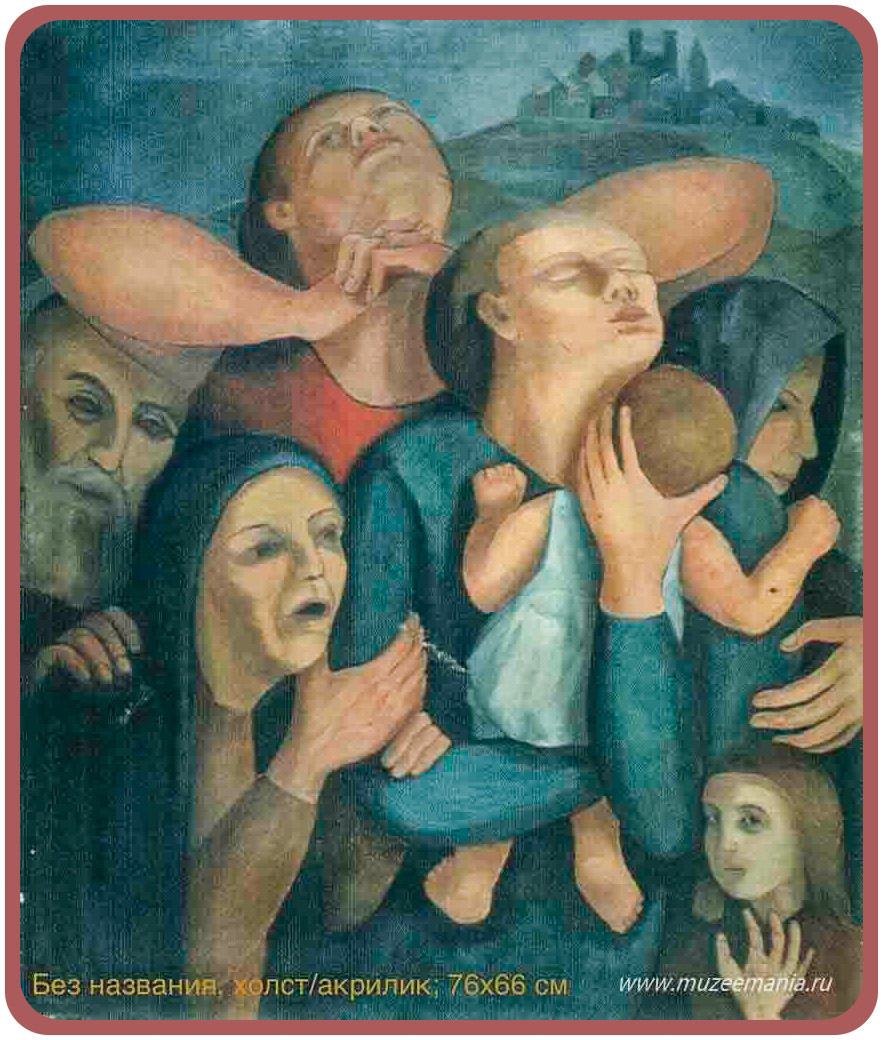
The image on the cover is a fragment of a painting by the Russian-French-American artist Alexandra Pregel (1907-1984). The painting is known among art historians as "The Horrors of War" (or "The Bitterness of War"), although the author herself left it untitled. After the occupation of Paris by German troops in 1940, the fate of about 300 paintings by Alexandra Pregel remained unknown. Source - muzeemania.ru.

.png) Dear reader, We invite you to share your opinion about this article and the Trust but Verify project in general through available communication channels. We will take your opinion into account when selecting content and verifying information. If your arguments are convincing, we are ready to make adjustments in evaluating statements, facts and conclusions.
Dear reader, We invite you to share your opinion about this article and the Trust but Verify project in general through available communication channels. We will take your opinion into account when selecting content and verifying information. If your arguments are convincing, we are ready to make adjustments in evaluating statements, facts and conclusions.