
Russia's Permanent Representative to the UN, V. Nebenzya, said in an interview with the BBC on 06.02.2024 that "the UN International Court of Justice ... refused to call Russia a terrorist state ... and rejected claims that Russia sponsored terrorism".
.png)
The validity of this statement was assessed by Igor Todorov, Doctor of Historical Sciences, Professor
Facts
In 2017, Ukraine filed a lawsuit with the UN International Court of Justice accusing the Russian Federation of violating the International Convention for the Suppression of the Financing of Terrorism (ICSFT) [1].
The basis for this accusation was data on Russia's transfer of weapons, including the Buk surface-to-air missile system that was used to shoot down passenger plane MH17, to the armed group Donetsk People's Republic.
Reference: Malaysia Airlines passenger airliner MH17 was shot down over eastern Ukraine on July 17, 2014, killing all 298 people on board.
The very fact that flight MH17 was struck by a missile from a Buk surface-to-air missile system brought from Russia on that day was proven earlier in the District Court in The Hague [2], and was not considered by the UN International Court of Justice.
When considering the lawsuit Ukraine v. Russian Federation, the UN International Court of Justice focused on the interpretation of the key concept of "funds," the provision or collection of which, according to the Convention (ICSFT), is the financing of terrorism [1, Article 2, paragraph 1].
The ICSFT itself defines the term "funds" as follows: "a assets of every kind, whether tangible or intangible, movable or immovable, however acquired, and legal documents or instruments in any form, including electronic or digital, evidencing title to, or interest in, such assets, including, but not limited to, bank credits, travellers cheques, bank cheques, money orders, shares, securities, bonds, drafts, letters of credit" [3, Article 1, paragraph 1].
The Parties had different understandings of such definition. Ukraine insisted on a broad understanding, in which "funds" include, among other things, weapons. Russia insisted on a narrow understanding of the term as financial funds only.
As a result of the discussion of this terminological dispute, the International Court of Justice sided with Russia, which is recorded in the final document [4, Article 2, paragraph (a)]: "In light of the foregoing, the Court concludes that the term “funds”, as defined in Article 1 of the ICSFT and used in Article 2 of the ICSFT, refers to resources provided or collected for their monetary and financial value and does not include the means used to commit acts of terrorism, including weapons or training camps. Consequently, the alleged supply of weapons to various armed groups operating in Ukraine, and the alleged organization of training for members of those groups, fall outside the material scope of the ICSFT. In the present case, therefore, only monetary or financial resources provided or collected for use in carrying out acts of terrorism may provide the basis for the offence of terrorism financing..."
As a result, the International Court of Justice issued a decision rejecting Ukraine's request to declare Russia responsible for sponsoring terrorism on the basis of this narrow understanding of the term "funds" [4, Section 2, Subsection C; 1, Articles 135-136].
Verdict
.jpg) V. Nebenzya's assertion is a manipulation. The UN International Court of Justice refused to find Russia responsible for sponsoring terrorism not because of the substance of the charges, but because of the interpretation of the concept of "funds", limiting them to financial resources only, excluding weapons.
V. Nebenzya's assertion is a manipulation. The UN International Court of Justice refused to find Russia responsible for sponsoring terrorism not because of the substance of the charges, but because of the interpretation of the concept of "funds", limiting them to financial resources only, excluding weapons.
Information sources
1. Application of the International Convention for the Suppression of the Financing of Terrorism and of the International Convention on the Elimination of All Forms of Racial Discrimination (Ukraine v. Russian Federation). Filed in the Registry of the International Court of Justice, 16 January 2017.
2. Transcript of the MH17 judgment hearing.
3. International convention for the suppression of the financing of terrorism. United Nations, 1999.
4. Application of the International Convention for the Suppression of the Financing of Terrorism and of the International Convention on the Elimination of All Forms of Racial Discrimination (Ukraine v. Russian Federation). Summary of the Judgment of 31 January 2024.
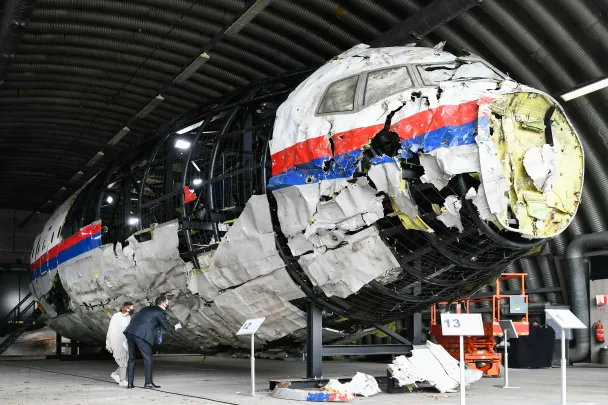 Cover image - Judges and lawyers inspect a reconstruction of Flight MH-17 made from debris collected at the crash site. Photo: Piroschka van de Wouw / Getty Images.

.png) Dear reader, We invite you to share your opinion about this article and the Trust but Verify project in general through available communication channels. We will take your opinion into account when selecting content and verifying information. If your arguments are convincing, we are ready to make adjustments in evaluating statements, facts and conclusions.
Dear reader, We invite you to share your opinion about this article and the Trust but Verify project in general through available communication channels. We will take your opinion into account when selecting content and verifying information. If your arguments are convincing, we are ready to make adjustments in evaluating statements, facts and conclusions.