
This article is the first part of a detailed report (the full report in PDF format is available here) on our fact-checking investigation of the missile attack on the Okhmatdyt children's hospital in Kyiv on July 8, 2024. This part provides the rationale for estimates of the parameters of the missile that hit Ohmatdyt and compares them with the characteristics of the X-101 missile.
.png)
Article editor: Mark Beygelzimer, PhD, systems analyst, head of the Trust but Verify project.
1. Estimates of the parameters of the missile that hit Okhmatdyt
To estimate the parameters of the missile that hit Okhmatdyt children’s hospital, we used a video recording of the final section of its flight before hitting the hospital. A fragment of this video is shown in Video 1.
Video 1. Missile strike on the Okhmatdyt hospital on July 8, 2024 at 10:45 (source - Telegram-channel of journalist Andrei Tsaplienko)
1.1. Length
The length of the missile was estimated from its image in the still image of Fig. 1. The camera was filmed almost perpendicular to the plane of flight of the missile (more precisely, at an angle of approximately 88° - see Fig. 2), so its linear dimensions in the still image are not distorted. The height of the floor of the building of the Ministry of Infrastructure of Ukraine was chosen as the scale.
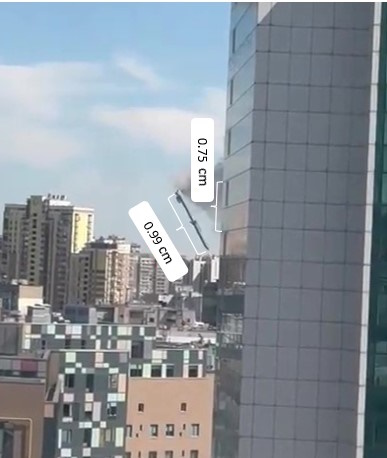
Figure 1. Still image from Video 1 used to estimate the length of the missile:
0.99 cm - length of the missile image in the photo viewer; 0.75 cm - height
of the image of the floor of the building of the Ministry of Infrastructure of Ukraine building
The calculation is done as follows:
Missile length ≈ 0.99 х 3.66 / 0.75 х 280 / 181 = 7.5 meters, (1)
where 0.99 cm is the length of the missile image in Fig. 1 (hereinafter all linear dimensions of images are defined in the conventional scale of the image viewer); 0.75 cm is the height of the image of the floor of the building of the Ministry of Infrastructure in Fig. 1; 3.66 m - the actual height of the floor of this building in meters (the height of the building on the roof - 106 m, the number of floors including technical - 29 [1]); 280 m - the distance from the video camera lens to the missile at the moment of the freeze frame (see Fig. 2); 181 m - the distance from the video camera lens to the corner of the building, by which the height of the floor on the freeze frame is estimated (see Fig. 2).
The accuracy of the missile length estimation is ±0.5 m, taking into account the possible error of the values in formula (1).
So, the length of the missile that hit Okhmatdyt was 7.5 ± 0.5 meters.
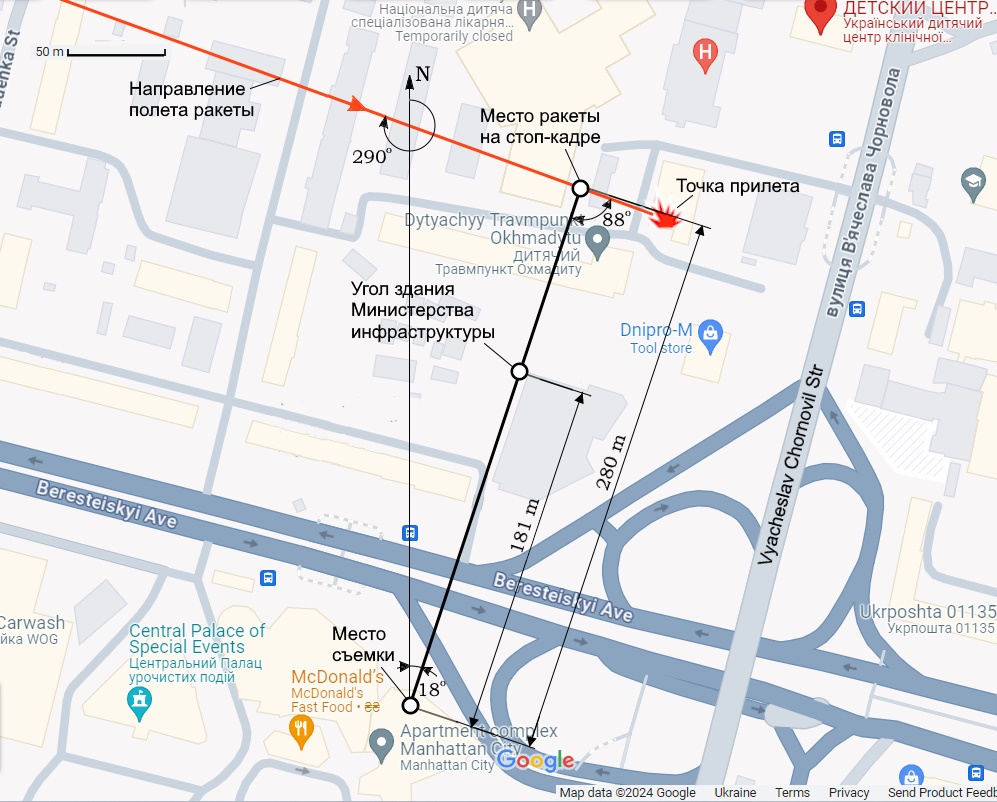
Fig. 2. Map of the area where the missile fell on the territory of Okhmatdyt on July 8, 2024 at 10:45.
The azimuth of the missile's arrival (290°) is set along its trajectory (see Fig. 3).
The location of the shooting was taken according to the data of Conflict Intelligence Team [2] and the Ministry of Justice of Ukraine [3].
The place of the missile's arrival was geolocated according to numerous photo and video documents [4-6].
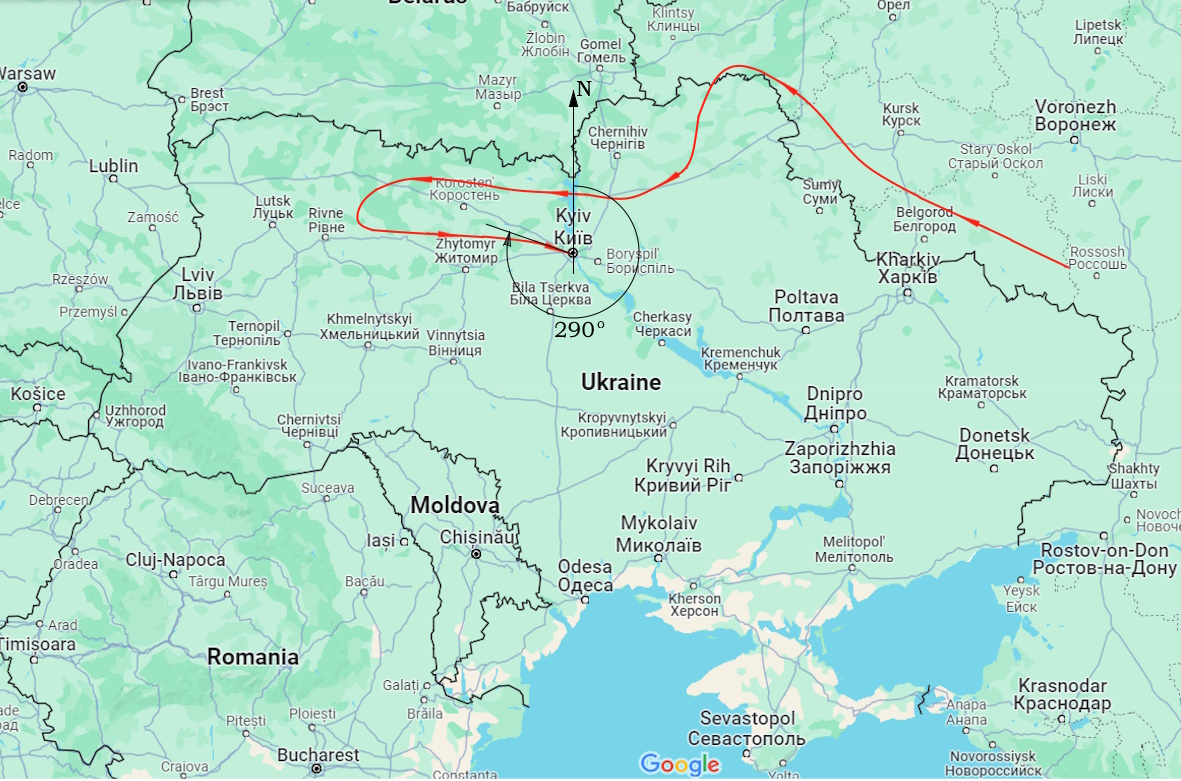
Figure 3. Trajectory of the missile that struck the Okhmatdyt children's hospital in Kiev
on July 8, 2024, at 10:45 (source - war_monitor [7]). Just before the impact,
the missile was flying from west to east along an azimuth of 290°.
1.2. Diameter
We estimated the diameter of the missile from the still image shown in Fig. 4. The calculation is performed as follows:
Missile diameter ≈ 0.8 х 7.5 / 8.3 = 0.72 m, (2)
where 0.8 cm and 8.3 cm are respectively the width and length of the missile image on the still image; 7.5 m is an estimate of the natural length of the missile according to formula (1).
The accuracy of the missile diameter estimation is ±0.1 m, taking into account the possible error of the values in formula (2).
So, the diameter of the missile that hit Okhmatdyt was 0.72 ± 0.1 m.
.jpg)
Figure 4. Dimensions on the still image (in the photo viewer)
used in estimating the missile diameter and engine dimensions
1.3. Engine
We identified the detail at the bottom of the tail part of the missile image in video 1 as the missile engine. Its dimensions are estimated as follows (Fig. 4):
Larger engine size ≈ 1.0 х 7500 / 8.3 = 900 mm, (3)
where 1.0 cm and 8.3 cm are, respectively, the length of the engine and the length of the missile in the still image; 7500 mm is an estimate of the natural length of the missile according to formula (1).
Smaller engine size ≈ 0.4 х 7500 / 8.3 = 360 mm, (4)
where 0.4 cm is the width of the engine image on the still image; 8.3 cm and 7.5 m are the same as in formula (3).
The accuracy of the missile engine size estimation is ±100 mm, taking into account the possible error of the values in formulas (3) and (4).
The movement of the missile was accompanied by the whistling and rustling sound that is characteristic of a turbojet engine (turn video 1 on full volume to hear the sound more clearly).
So, the missile had a 900 ± 100 / 360 ± 100 mm turbojet engine located externally at the bottom of the tail section of the missile.
1.4. Wings
In video 1, when the missile appears in the field of view of the video camera, the wings are not visible (first still image in Fig. 5). After 0.1 sec, the wings of the missile are already visible (second still image in this figure), and after 0.2-0.4 sec they are clearly visible (third and fourth still images). On this basis:
1) The missile had wings in its midsection.
2) During the approach to the ground, the missile experienced a roll, because of which its wings became visible only when the plane of the wing tilted toward the video beam. And here we are talking about the roll and not about the constant rotation of the rocket around the longitudinal axis, since the visible wing span clearly increased during the first 0.2 sec, but practically did not change during the next 0.2 sec (between the third and fourth still images in Fig. 5).
3) There were exactly two wings on the body of the rocket, because if there were more wings (three or four), they would be visible at any roll of the rocket, and in our case at the initial moment the wings are not visible (the first still image).
4) The wings are located at the bottom of the hull.
So, the missile in its midsection had two wings at the bottom of the hull.
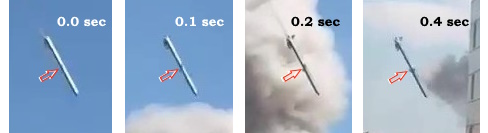
Figure 5. Sequence of still images from video 1, showing how the wings of the missile "appear" as a result of its roll.
1.5. Trajectory
In the final part of its trajectory, which is actually seen in video 1, the missile flies strictly in a straight line inclined at an angle of about 60° to the horizontal. At the same time, the missile motion was stable, without any oscillations and rotations around its transverse axes.
So, the missile was diving on the target at an angle of about 60° to the horizon without yaw or pitching.
1.6. Speed
We estimated the missile's flight speed from a 10 times slower video (see video 2). The calculation is performed as follows:
Missile speed ≈ 103 / 5.3 / 10 х 3.6 = 702 km/h, (5)
where 103 m is the length of the segment of the rocket's path where the time is measured (between points 1 and 2 in Fig. 6, this segment is 13.8 times longer than the length of the missile itself, which, as established earlier, is approximately 7.5 m - see formula (1)); 5.3 s - the time of the missile's passage of this segment on the slow motion video 2; 10 - the rate of video slowdown; 3.6 - the coefficient of conversion of m/s into km/h.
The calculation of the speed according to (5) takes into account that the missile according to video 1 was moving in a straight line. The accuracy of the speed estimation is ±100 km/h, considering the possible error of the values in (5).
So, the missile speed when diving on the target was 700 ± 100 km/h.
Video 2. Fragment of video 1, slowed down 10 times.
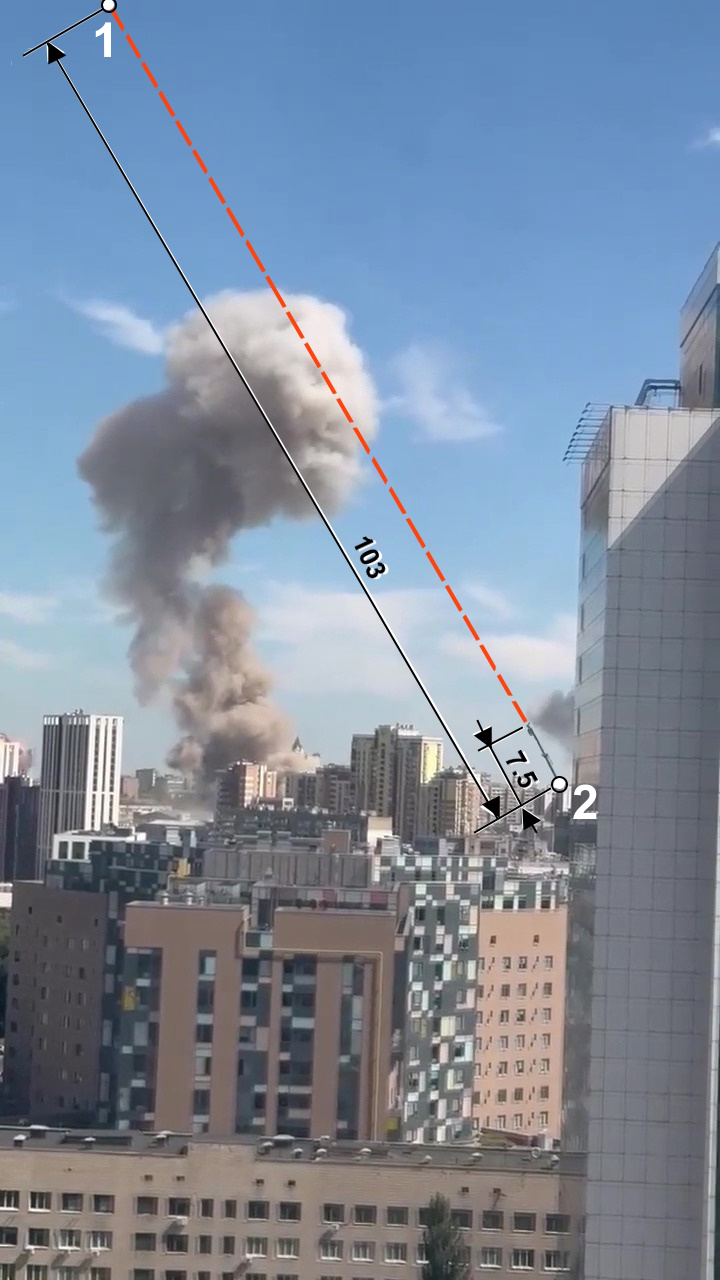
Figure 6. Schematic for calculating the speed of the missile between points 1 and 2.
2. Comparison of the parameters of the missile that hit Okhmatdyt with the characteristics of the Kh-101 missile
The Kh-101 is a Russian strategic air-to-ground cruise missile. During flight, the missile's engine and wings are extended from the hull, so its appearance in the air is best represented not by full-scale photographs in transport condition, but by a model (Fig. 7) and separate views (Fig. 8).
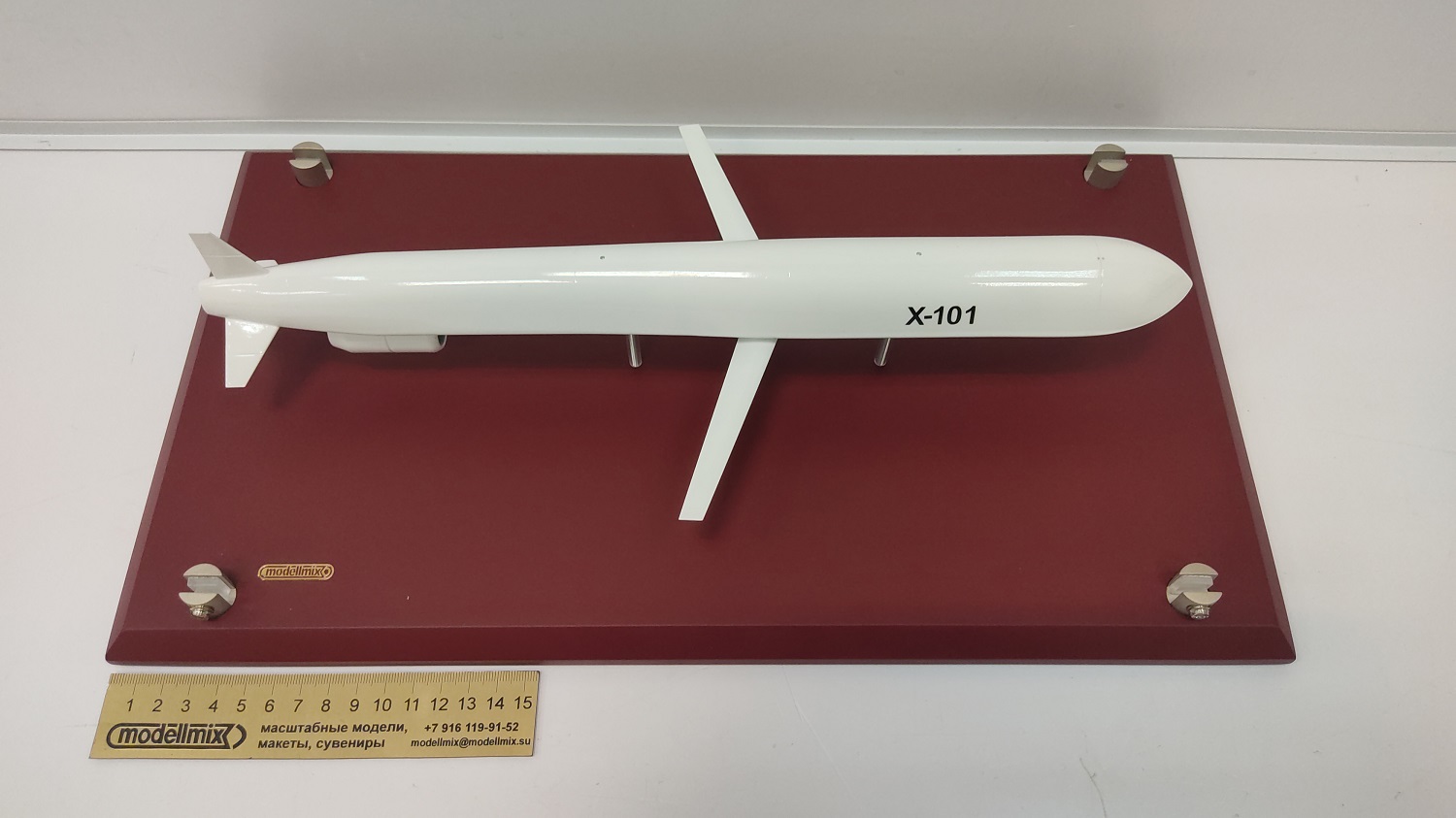
Fig. 7. Scaled model of the Kh-101 missile in the flight state (source — modellmix).
_eng.jpg)
Figure 8. Kh-101 missile. Top and side views (adapted by us from Flibusta)
Comparison of technical characteristics of the Kh-101 missile [2; 8-11] (to the left of the slash) and the missile that hit the Okhmatdyt children's hospital (to the right of the slash) :
• Length: 7.45 m / 7.0...8.0 m 
• Diameter: 0.74 m / 0.62...0.82 m
• Length to diameter ratio: 10 / 8.5...13.0
• Engine type: Turbojet R95TM-300 / Turbojet
• Engine length: 850 mm / 800...1000 mm
• Engine diameter: 315 mm / 260...460 mm
• Engine location: Outside at the bottom of the tail / Outside at the bottom of the tail
• Number of wings: 2 / 2
• Wing arrangement: In the middle part at the bottom / In the middle part at the bottom
• Approach trajectory on target: Gains altitude and dives at 45-60° / Was diving at a 60° angle
• Dive speed: No more than 900 km/h / 600...800 km/h
Fig. 9 shows a visual comparison of the view of two missiles (Kh-101 and the one that hit Okhmatdyt) from the same angle, made by Bellingcat group [11].
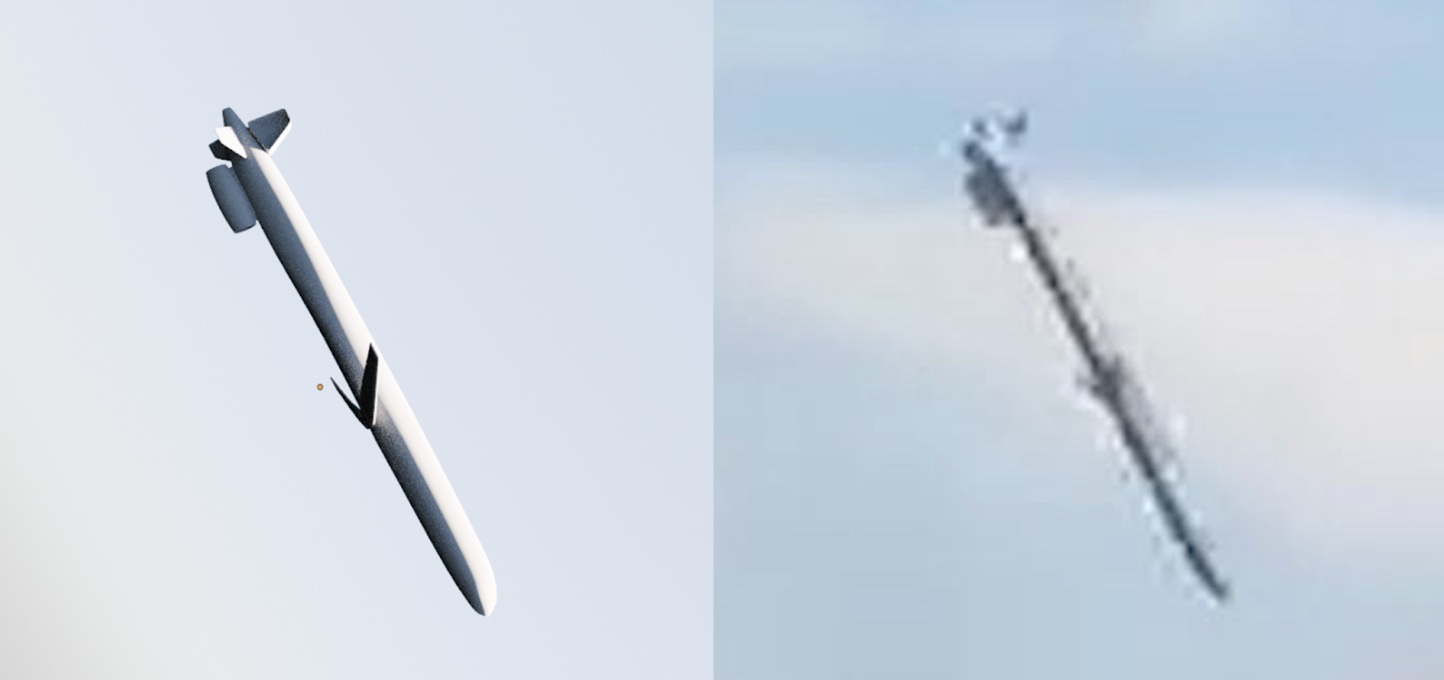
Figure 9. Left - 3D model of the Kh-101 missile. On the right - screenshot of the missile
that hit the Okhmatdyt children's hospital on July 8. Source - Bellingcat.
So, estimates of all the parameters of the missile that hit Okhmatdyt correspond to the characteristics of the X-101 missile.
Sources of information
1. Building of the Ministry of Transport of Ukraine on SkyscraperPage.com Archived May 15, 2012 at the Wayback Machine
2. CIT. A breakdown of the strike on the Okhmatdyt hospital. July 9, 2024 [in Russian].
3. V. Romanenko. Russian strike on Okhmatdyt hospital: experts identified more than 30 parts and fragments of the Kh-101 missile - photos. Ukrainska Pravda, July 10, 2024.
4. I. Labyak. All about the brutal attack on Okhmatdyt hospital in Kiev: there are victims and wounded, people are looking for under the rubble (photo, video). TSN, July 08, 2024 [in Ukrainian].
5. Andriy Tsaplienko Telegram-channel [in Russian].
6. Facebook page of VATL "Okhmatdyt".
7. monitor Telegram-channel.
8. Kh-101. Article in Wikipedia.
9. R95-300. Article in Runiversalis.
10. I. Volzhsky. Indefensible. Novaya Gazeta Europe, July 10, 2024.
11. Bellingcat website. Russian Missile Identified in Kyiv Children’s Hospital Attack. July 09, 2024.
12. Experts on the strike on a children's hospital in Kiev: "It was a Russian missile". BBC News. Russian Service. July 9, 2024 [in Russian].
Cover image is from UNN
.png) Dear reader, We invite you to share your opinion about this article and the Trust but Verify project in general through available communication channels. We will take your opinion into account when selecting content and verifying information. If your arguments are convincing, we are ready to make adjustments in evaluating statements, facts and conclusions.
Dear reader, We invite you to share your opinion about this article and the Trust but Verify project in general through available communication channels. We will take your opinion into account when selecting content and verifying information. If your arguments are convincing, we are ready to make adjustments in evaluating statements, facts and conclusions.