
On April 29, 2025, Moskovsky Komsomolets and Pravda.ru announced that the “Zhukovsky Research Center conducted the world's first supersonic civilian airplane test” (similar information ran in dozens of other Russian publications, see, for example, here, here and here). This news was based on a publication in the official Telegram channel of the Russian Government and was supported by a short video clip of the tests.
The substance of the issue was sorted out by the experts at Trust but Verify.
.png)
Article Editor: Mark Beygelzimer, PhD, systems analyst, head of the Trust but Verify project.
Facts
---------- 1 ----------
Supersonic passenger airplanes were in service decades ago (Soviet Tu-144 from 1975 to 1978, European Concorde from 1976 to 2003).
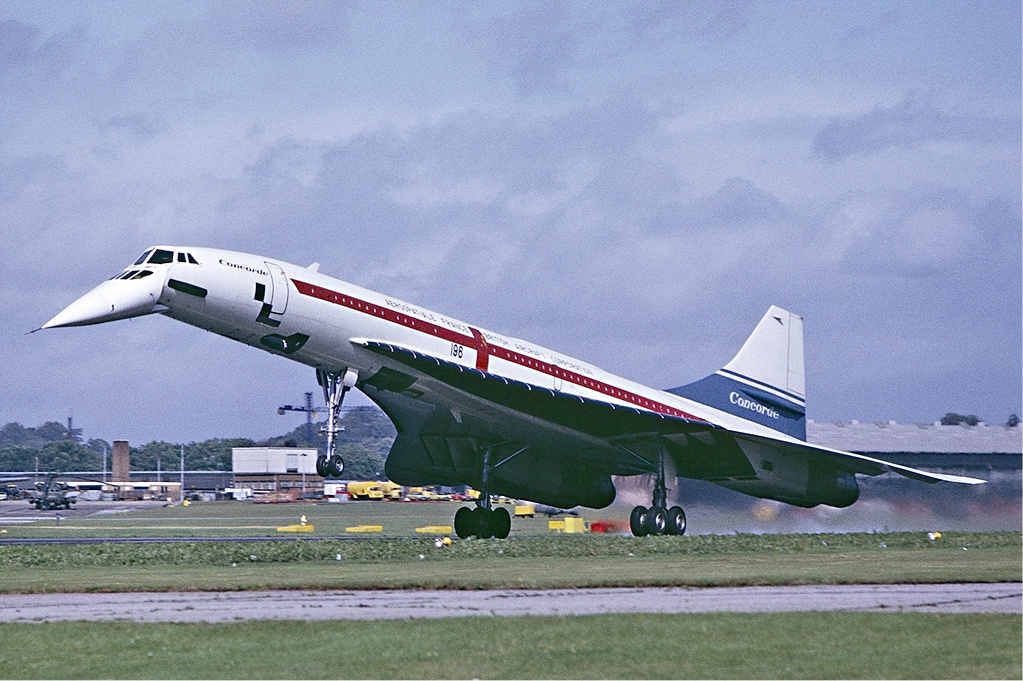 Concorde on landing. The nose fairing is lowered.
Authorship: Steve Fitzgerald. http://www.airliners.net/photo/British-Aircraft-Corporation/Aerospatiale-BAC-Concorde/1804269/L/, GFDL 1.2, https://commons.wikimedia.org/w/index.php?curid=16537090
Therefore, the information of the Russian government and Russian media about “breakthrough tests” may refer exclusively to the development of promising supersonic airplanes aimed at eliminating known technical problems. One such problem is related to the long, aerodynamically streamlined nose section of the fuselage, which limits the pilots' view during takeoff and landing. In the Tu-144 and Concorde, this problem was solved by using a movable nose section: during takeoff and landing, it tilted downward, providing pilots with the necessary view, and in cruising flight it returned to its original position along the longitudinal axis of the aircraft.
---------- 2 ----------
The essence of the tests conducted at SIC “Institute named after N.E. Zhukovsky” in 2025 was that the pilot controlled the flight of a passenger airliner not in the traditional way (using the cockpit glazing for visual perception of the surrounding space), but with the help of an external vision system including visible and infrared cameras. In other words, the pilot did not have a windshield in front of him, but a screen on which signals from video cameras and other sensors were displayed.
The tests used an old Soviet aircraft Yak-40, developed back in the 1960s and has a maximum speed of 546 km/h , which is about 2 times lower than the speed of sound.
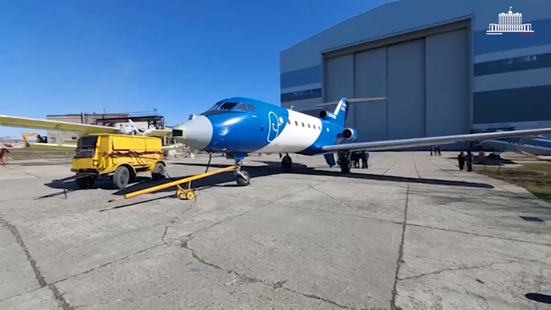 Yak-40 airplane used for tests at the Zhukovsky Research Center in 2025 (frame from video)
So it wasn't actually a supersonic civilian airplane that was tested, but an external vision system on a subsonic civilian airplane. It's just that the results obtained in the tests can theoretically be used for a supersonic civil aircraft.
---------- 3 ----------
That these tests were “the first in the world” is also not true. External vision systems have long been actively used in military aviation (see, for example, here). In addition, for several years, the United States and China have been developing a new generation of supersonic civilian airplanes equipped with augmented reality systems with external vision cameras (The first-generation supersonic airplanes - the TU-144 and Concorde - did not have full-fledged external vision systems). For example, the prototype of the supersonic passenger airplane Boom Overture (developed by the American company Boom Technology) has already made more than 10 flights by February 2025, including at supersonic speed.
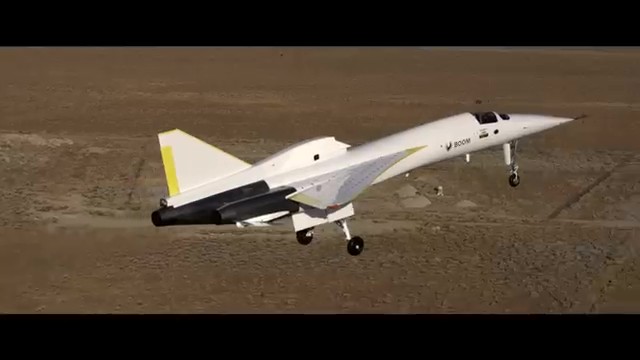 Boom XB-1 aircraft (Boom Overture prototype) before landing after its second supersonic test flight (frame from video)
-------------------------------------
Thus, the information about the world's first tests of a supersonic civilian airplane has nothing to do with reality and is designed to “balance” in the public consciousness the crisis phenomena in the Russian aviation industry, because of which, for example, the Federal Air Transport Agency is forced to extend the service life of passenger planes like Yak-40 from the current 50 to 60 years.
Thus, the information about the world's first tests of a supersonic civilian airplane has nothing to do with reality and is designed to “balance” in the public consciousness the crisis phenomena in the Russian aviation industry, because of which, for example, the Federal Air Transport Agency is forced to extend the service life of passenger planes like Yak-40 from the current 50 to 60 years.
Verdict
 Russian media claims that "Russia has conducted the world's first supersonic civilian airplane test" contain two untruths. In fact, it was not the supersonic airplane itself that was tested, but the external vision system installed on the subsonic airplane. Secondly, such systems have long been used in supersonic military aviation and are being actively developed for promising supersonic civil aircraft in the United States and China.
Cover: British-French supersonic passenger Concorde (2000s). Photo: Ian Waldie/Getty Images. Photo source: The Guardian


.png) Dear reader, We invite you to share your opinion about this article and the Trust but Verify project in general through available communication channels. We will take your opinion into account when selecting content and verifying information. If your arguments are convincing, we are ready to make adjustments in evaluating statements, facts and conclusions.
Dear reader, We invite you to share your opinion about this article and the Trust but Verify project in general through available communication channels. We will take your opinion into account when selecting content and verifying information. If your arguments are convincing, we are ready to make adjustments in evaluating statements, facts and conclusions.