
The essay by Yuriy Khristensen (analyst of the media center of the Odessa Political Platform) is not only a sample of brilliant publicism, but also a living example of critical thinking. Its author is from Ukraine, so the words “our”, “we” refer to Ukrainians. The source of the text is Echo, the original is the Facebook page of Yuriy Khristensen.
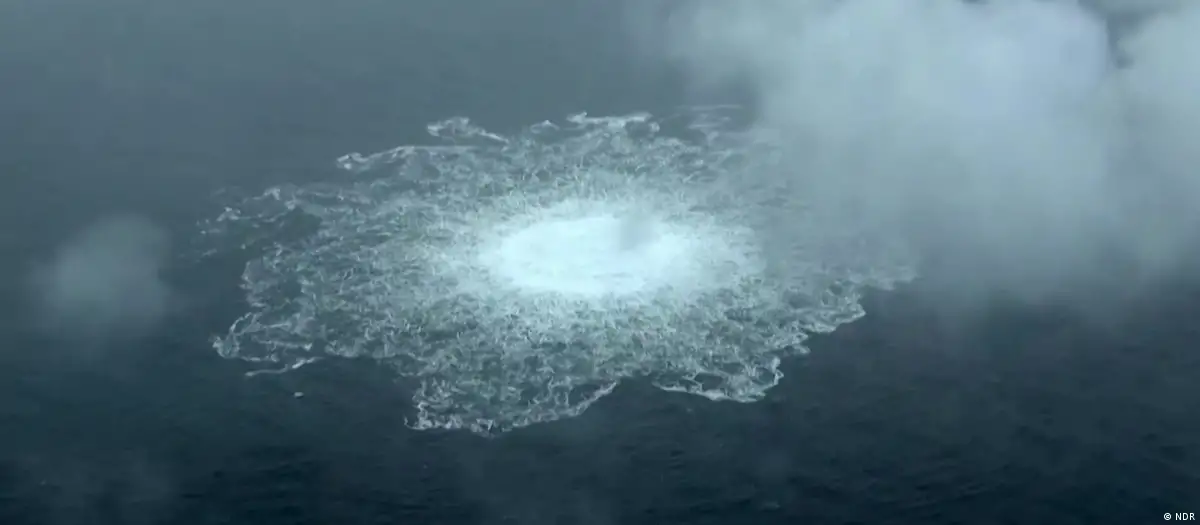
Reference (from Wikipedia): The Nord Stream and Nord Stream 2 pipeline sabotage was carried out on September 26, 2022, against the backdrop of a full-scale Russian invasion of Ukraine, at the height of the gas conflict between Russia and the European Union. A series of explosions in the exclusive economic zones of Denmark and Sweden destroyed both strings of Nord Stream-1 and one of the two strings of Nord Stream-2. At the time of the accident, no gas was being pumped through them: NS-1 was stopped by the Russian side, while NS-2 has not been launched. In August 2024, the Western media began to actively disseminate the version of Ukraine's involvement in the Nord Stream explosions.
***
- Did our people blow up Nord Stream?
- How could they blow it up?
- They brought in explosives, planted them near the pipe and blew it up.
- You have a domestic approach to blowing up gas pipelines. They bought potatoes, peeled them, put them on the fire. If it were that easy, you wouldn't need a special services apparatus.
- What's so complicated about it?
- Let's start with “brought in explosives.” We open Google and read about the Litvinenko and Skripal poisoning. We look at operations to deliver a few milligrams of special agents to the right place in the EU. We compare it to hundreds of kilograms of explosives and conclude that it is not easy.
Special laboratories have to produce a special agent. Special courses to train saboteurs. Special academies to train those who plan such operations. All these wonderful people have to work thousands of man-hours to put a drop of poison in tea, or put it on a doorknob.
- So thousands...
- Read about Navalny's poisoning. How many agents spent months preparing an operation to put a drop of special agent on a man's underwear. And that's on their own soil. It's much more complicated on the territory of another state.
- Maybe they bought the explosives locally.
- You got a friend in the Netherlands, ask her to buy a ton of octogenes locally.
- That's a friend, that's the secret service!
- Okay, let's say they somehow got the explosives. Now let's say they need to accomplish a simpler task. Find the bottom of the Baltic and damage a communications cable. Russia has a special fleet for this sort of thing. The Losharik submarine, manned by the elite, from lieutenant captain upwards. Does Ukraine have such a fleet? Has it ever set itself such tasks?
- It is written that they rented a yacht.
- Do you think that if a small yacht would be enough to carry out underwater sabotage at a depth of a hundred meters, Russia would build a fleet with special equipment?
- Ours are more creative.
- Not creative enough to defy the laws of physics. The pipe was blown at a depth of 80 meters. You open Google and look up the necessary diving equipment.
- They say we blew it up.
- Do they give you proof?
– Sources cited.
- Six months after the Litvinenko poisoning, British police have named suspects. Six months after the poisoning of the Skripals, they published a photo of the saboteurs. With a lot of evidence. After Navalny's poisoning, journalists posted evidence four months later. And here it's always anonymous sources. Doesn't that remind you of anything?
- That's what the Western newspapers say.
- During the interference in the US election in 2016, disinformation was also leaked through Western media. Then there was a special prosecutor's investigation. It turned out that the Russian GRU GSH was hiding behind “anonymous sources”.
Let me give you another example - the Russian missile attack on the Malaysian Boeing. How much disinformation was then spread through the Western media? With the “Spanish Dispatcher” and other “sources”.
- So, it was not ours who blew up the “streams”?
- External signs speak against this version. It is not Ukraine that maintains a fleet for underwater sabotage. It's not Ukraine that trains saboteurs. Not in Ukraine operates a poison laboratory. Not in Ukraine is located the Red Banner Institute, the Academy of Foreign Intelligence and other institutions for the reproduction of totalitarian practices. And it is not Ukraine that invests billions in spreading disinformation around the world.
- But people believe it.
- For disinformation to spread better, it must be absurd. After the shooting down of MH17, the General Staff of the Russian Armed Forces claimed that it was done by a Ukrainian attack aircraft. But attack aircraft may not be able to shoot down an airplane at an altitude of 10 km. And small yachts can't hold deep-sea diving equipment. So disinformation is presented in a simplistic way.
- I bought potatoes, peeled them and put them on the fire.....
- Yes. The experts start discussing the inconsistencies, and that just pours water on the propagandists' mill. Because most people have never flown in an attack aircraft or gone down to deep water. Most are content with “everyday” explanations.
- So now everyone has to fly an attack plane?
- Not necessarily. A rudimentary analysis of known, repeated facts will suffice.
- That's easy to say.
- It's a matter of survival. It is the spread of disinformation that allows totalitarian institutions to commit crimes in plain sight and evade responsibility. Until we learn to analyze, we will be victims of crime.
- We will never learn.
- You can fool one person forever. You can fool everyone for a while. But you can't fool everyone forever. We're already learning. If we hadn't, we'd have lost in the first weeks of the war.
Yuri Christensen, August 16, 2024.
Cover photo: The surface of the Baltic Sea above the site of the Nord Stream explosion, October 9, 2023. Author: NDR, source: DW
.png) Dear reader! We invite you to share your opinion about this article and the Trust but Verify project in general through available communication channels.
Dear reader! We invite you to share your opinion about this article and the Trust but Verify project in general through available communication channels.