
This article is the second part of a detailed report (the full report in PDF format is available here) prepared by Trust but Verify as part of a fact-checking investigation into the missile attack on the Okhmatdyt children's hospital in Kyiv on July 8, 2024. The first part of the report assessed the parameters of the missile that attacked Ohmatdyt and found that all these estimates fully correspond to the characteristics of the X-101 missile. The second part analyzes the arguments against the fact that it was an X-101 missile.
.png)
Article editor: Mark Beygelzimer, PhD, systems analyst, head of the Trust but Verify project.
3. Analysis of counterarguments to the version of the Kh-101 missile strike on Okhmatdyt
Argument 3.1. “In the still image of the missile flying near the wall of the Ministry of Infrastructure building (see Figure 1 in the first part), its length is comparable to the floor height of 3-4 m, which is about half the length of the Kh-101 missile”.
This argument is flawed because it does not take into account the perspective of the image: the missile is about 2 times farther away from the video camera than the Ministry of Infrastructure building. Therefore, the actual length of the missile is about twice the floor height of the building (this is taken into account above in formula (1), which gives an estimate of the missile length taking into account the perspective).
Argument 3.2. “The wings of the Kh-101 missile would not be visible in a side or close up shot, but in the still image (see Figure 1 in the first part) they are visible”.
This argument is erroneous. The visible wingspan of the X-101 depends on the roll of the missile (Fig. 10). When shooting from a side view and zero roll, the wings, indeed, are not visible. But already at a roll of 10° visible wingspan of the X-101 missile is 521 mm, at 20° - 1026 mm, and at 30° - 1500 mm. This is clearly confirmed by frame-by-frame analysis of video 1 (see the first part), from which it follows that at first the wings are not visible and "appear" only as the roll of the missile increases (see Fig. 5 in the first part).
%20eng.jpg) Figure 10. Schematic explaining the change in the apparent spread of the wing
Figure 10. Schematic explaining the change in the apparent spread of the wing
of the Kh-101 missile when its roll increases (all dimensions are in mm)
Argument 3.3. “Russia could not have launched the missile in such a way that it came from the west”.
This is not true, since we are talking about a cruise missile, not a ballistic missile. A cruise missile can approach a target from any direction, regardless of where it is launched. In this case, the trajectory of the missile was as shown in Fig. 3 in the first part, i.e., the missile initially flew from east to west and then reversed direction from west to east.
Argument 3.4. “Cruise missiles do not dive at 60° because they fly low to the ground”.
This is not true. The Kh-101 missile, like other cruise missiles, gains altitude before the target, and then dives at the target in a straight line inclined at an angle of 45-60° to the horizontal (Figure 11). This was the trajectory observed in the case under consideration.
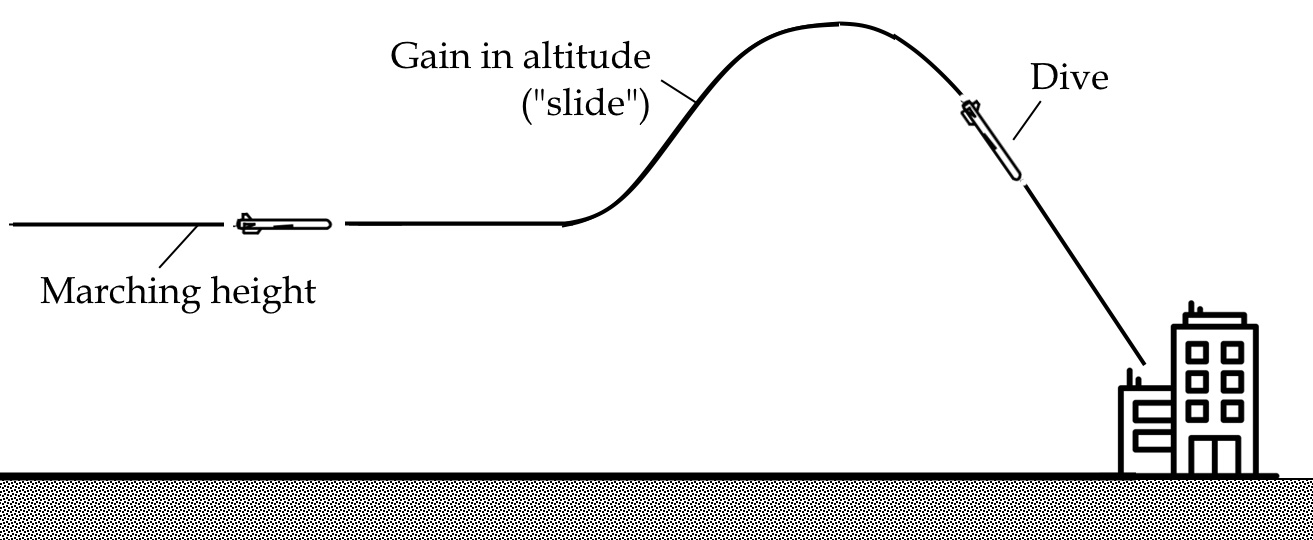
Figure 11. Diagram of the trajectory of a cruise missile in front of the target
Argument 3.5. “In the video (see video 1 in the first part), the missile moves silently, without the characteristic whistle of the turbojet engine, although the sound of impact on the hull of Okhmatdyt is clearly audible”.
This argument is based on the false claim: in fact, the sound of a turbojet engine can be heard in the above video. This can be easily verified by watching the video at full volume. .
Argument 3.6. “The scale of destruction is less than that of the X-101 missile impact”.
This argument is untenable. As a result of the missile attack, the two-story brick building of the hospital was destroyed, with an area of more than 100 m2 being razed to the ground. The surrounding buildings had their windows blown out and their facades damaged (Figure 12). The assertion that these destructions are small for the X-101 missile is unfounded and is not supported by practical data.
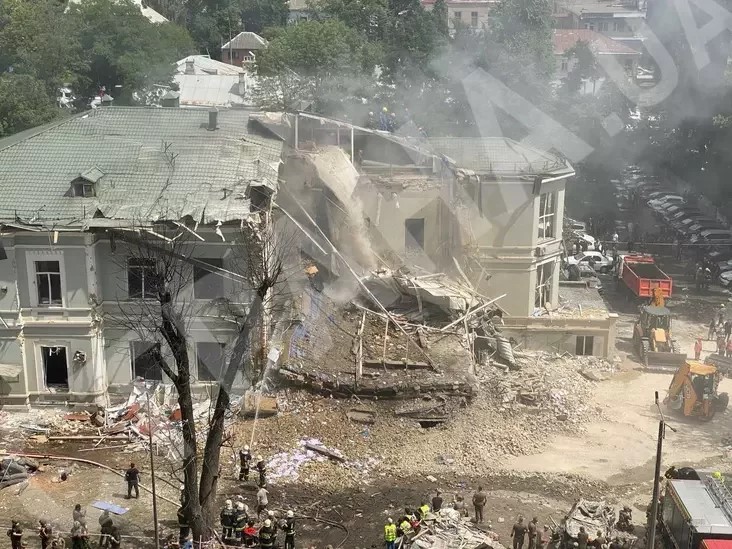
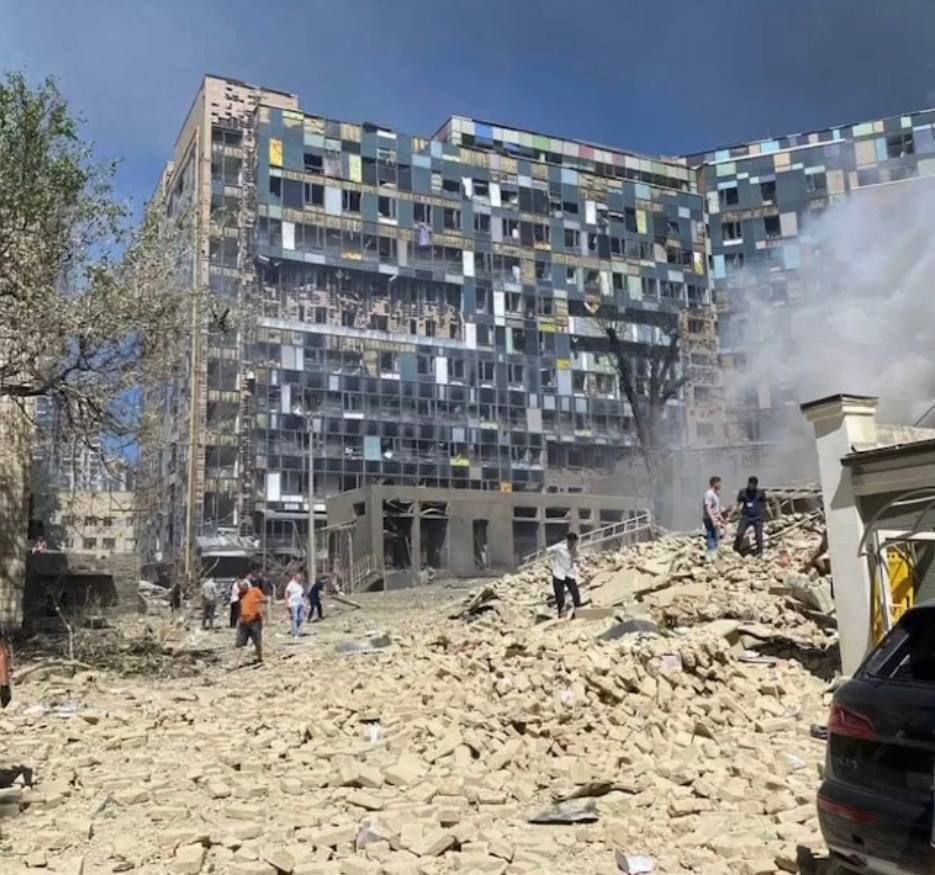
Figure 12. Photos showing the scale of destruction caused by a missile strike on the Okhmatdyt children's hospital on July 8, 2024.
Top: one of the buildings destroyed. Photo arrowsmap / Telegram (source — Nasha Niva).
Below: windows were broken out and the facade of the new building of the children's hospital "Okhmatdyt" was damaged. Photo source: Andriy Tsaplienko's Telegram channel

Argument 3.7. “Damage to surrounding buildings was caused by small destructive elements (shrapnel) typical for air defense missiles, but not for the Kh-101 missile”.
This argument is untenable. It is known that during the latest modernization of the Kh-101 missile, its warhead was almost doubled (up to 800 kg) due to a new warhead equipped with shrapnel (penetrating elements of cubic shape) [13-14]. This was confirmed, in particular, after studying the Kh-101 missile shot down during the attack by the Russian army on the night of March 29 [15]. Therefore, even if the damage to the surrounding buildings was indeed caused by shrapnel (and not by other small parts scattered in the explosion, such as brick or tile fragments), this shrapnel could well have come from the Kh-101 missile.
Thus, all the arguments of the opponents of the version of the strike on the Okhmatdyt children’s hospital by the missile Kh-101 are based on erroneous statements.
Sources of information
1. Building of the Ministry of Transport of Ukraine on SkyscraperPage.com Archived May 15, 2012 at the Wayback Machine
2. A breakdown of the strike on the Okhmatdyt hospital. July 9, 2024 [in Russian].
3. V. Romanenko. Russian strike on Okhmatdyt hospital: experts identified more than 30 parts and fragments of the Kh-101 missile - photos. Ukrainska Pravda, July 10, 2024.
4. I. Labyak. All about the brutal attack on Okhmatdyt hospital in Kiev: there are victims and wounded, people are looking for under the rubble (photo, video). TSN, July 08, 2024 [in Ukrainian].
5. Andriy Tsaplienko Telegram-channel [in Russian].
6. Facebook page of VATL "Okhmatdyt"
7. monitor Telegram-channel.
8. Kh-101. Article in Wikipedia.
9. R95-300. Article in Runiversalis.
10. I. Volzhsky. Indefensible. Novaya Gazeta Europe, July 10, 2024.
11. Bellingcat website. Russian Missile Identified in Kyiv Children’s Hospital Attack. July 09, 2024.
12. Experts on the strike on a children's hospital in Kiev: "It was a Russian missile". BBC News. Russian Service. July 9, 2024 [in Russian].
13. Y. Podolyaka. Whose missile fell near the Okhmatdyt hospital in Kiev: a parsing of "Military Chronicle". July 08, 2024 [in Russian].
14. Russian Federation began to produce Kh-101 missile with double warhead - media. PHOTO. Net, March 30, 2024.
15. Telegram channel Polkovnik GS. March 29, 2024 [in Russian].
The cover photo is of the destruction at the Okhmatdyt Children's Hospital (photo source: State Emergency Service of Ukraine).

.png) Dear reader, We invite you to share your opinion about this article and the Trust but Verify project in general through available communication channels. We will take your opinion into account when selecting content and verifying information. If your arguments are convincing, we are ready to make adjustments in evaluating statements, facts and conclusions.
Dear reader, We invite you to share your opinion about this article and the Trust but Verify project in general through available communication channels. We will take your opinion into account when selecting content and verifying information. If your arguments are convincing, we are ready to make adjustments in evaluating statements, facts and conclusions.