
Andrei Voznesensky wrote the poem "The Call of the Lake" in 1965, having been shocked by the story of a local resident from Ivano-Frankivsk region (Ukraine) during their fishing trip together: "There used to be no lake here, but a deep ravine. In 1942, the Nazis and their local collaborators drove Jews from the ghetto here and shot them. To hide the traces of the crime, the ravine was flooded with water from the nearby rivulet. And the fish catch here is excellent!" - the narrator rubbed his hands together in satisfaction.
.png)
Post editor - Galyna Nosovytska, author of the publications of the Trust but Verify project.
Reference: Andrei Voznesensky (May 12, 1933 - June 1, 2010) - One of the brightest Soviet poets of the sixties. A disciple of Mayakovsky and Pasternak. In his work, he defended freedom and personal dignity as the highest human values.
Call of the lake
(The English text below is a verbatim, not a literary translation of the Russian-language original from the source: poems.net.ua)
In memory of the victims of fascism
Pevzner 1903, Sergeev 1934,
Lebedev 1916, Birman 1938,
Birman 1941, Drobot 1907...
Our sneakers are freezing.
Silence.
Ghetto in the lake. Ghetto in the lake.
Three hectares of living bottom.
A citizen in a pea jacket
is calling for a glorious bite,
only the blood
on his tiny hook,
blood!
"I can't,- says Volodya.
but I can hit you on the snout,
I can't,
I can't get it into my brain!
I'll wash myself with living water,
maybe I'll splash someone's life.
Maybe Masha or Moisha
I'm smearing on my face.
Don't touch the water with your flat-bottom,
honorable invalid,
Feel it with the palm of your hand.
it hurts!
Maybe it's not someone else's palms either,
but my wife's palms,
shoulders, hair, waiting.
will be dissolved by someone else?
And with bazaars colossal
drumming its gills into the tin
what was warmth, what was eyes,
that loved to sit on my lap..."
"I can't,- says Volodya.
I just close my eyes -
in the cast-iron nights,
like fishes on frying pans,
women dancing and screaming!"
The third night Kostrov is drinking.
And at night he calls from the cliff.
And to him
Comes
A fish
The wonder-juice of the lake waters!
"Fish,
a flying fish,
with the fiery face of a madonna,
with fins as white
like a steam train whistle,
fish,
Reva was your name,
golden Reva,
Rivka, or something else,
with a piece
of barbed wire or a fishing hook
in its upper lip, a fish,
a fish of pain and sorrow,
forgive me, curse me, but answer me something..."
No response from the fish.
Quiet.
The lake is borderline.
Three pine trees.
The most marvelous repository
of life, of clouds, of heights.
Lebedev 1916, Birman 1941,
Roemer 1902, Boyko both 1933.
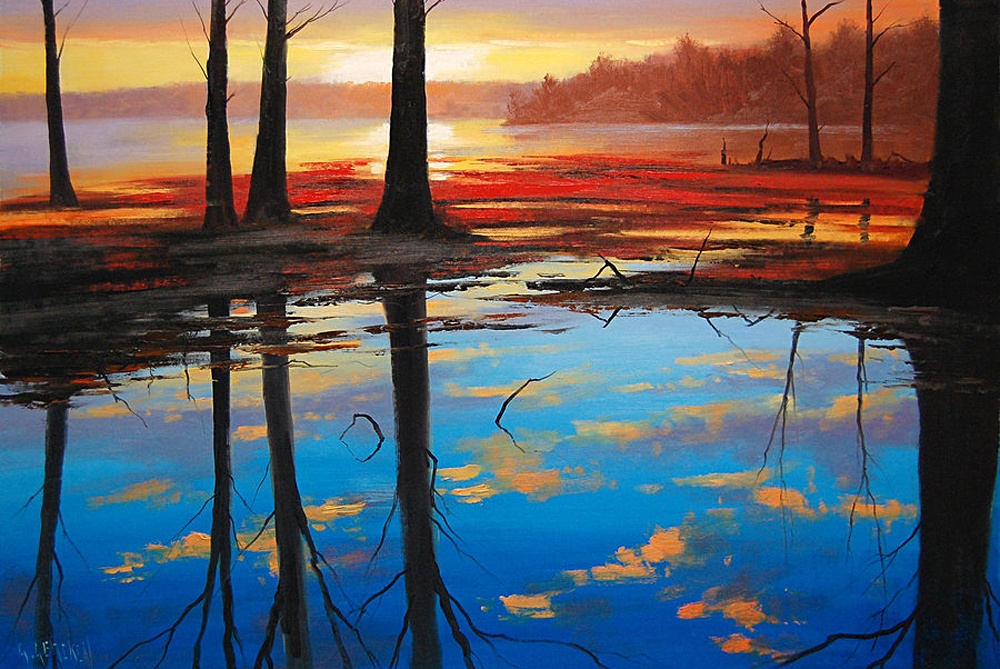
The cover image is a painting by Australian artist Graham Gercken
.png) Dear reader, We invite you to share your opinion about this post and the Trust but Verify project in general through available communication channels.
Dear reader, We invite you to share your opinion about this post and the Trust but Verify project in general through available communication channels.