
The Russian media is actively disseminating information that stealth technology was developed in the USSR by Soviet physicist Pyotr Ufimtsev, after which it was borrowed by US engineers [1-3].
.png)
The reliability of this version was assessed by Mark Beigelzimer , PhD, systems analyst, head of the Trust but Verify project.
Reference: Stealth technology (from the English Stealth - secretive) is a set of ways to reduce the visibility of combat vehicles (airplanes, helicopters, ships, missiles, drones, etc.) in radar, infrared and other areas of the spectrum due to special materials and special geometric forms. Currently used as a high-tech component of many modern models of military equipment in Russia, the USA and other countries.
Facts
In the United States, work to reduce the visibility of aircraft to enemy radars began in 1956. This was the government project RAINBOW (“Rainbow”), which was carried out by Lockheed together with the Lincoln Research Laboratory. To ensure competitiveness, in 1957 the aircraft manufacturing company Convair was also involved in work on stealth [4].
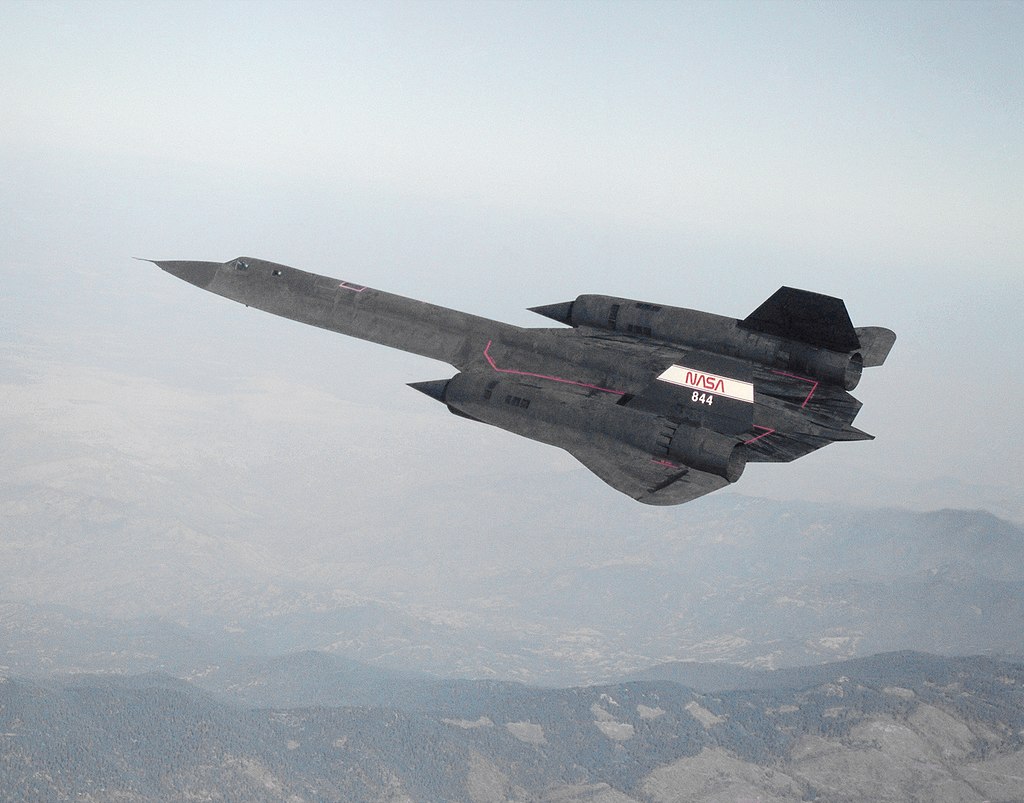 SR-71 in flight. NASA, Public domain, via Wikimedia Commons
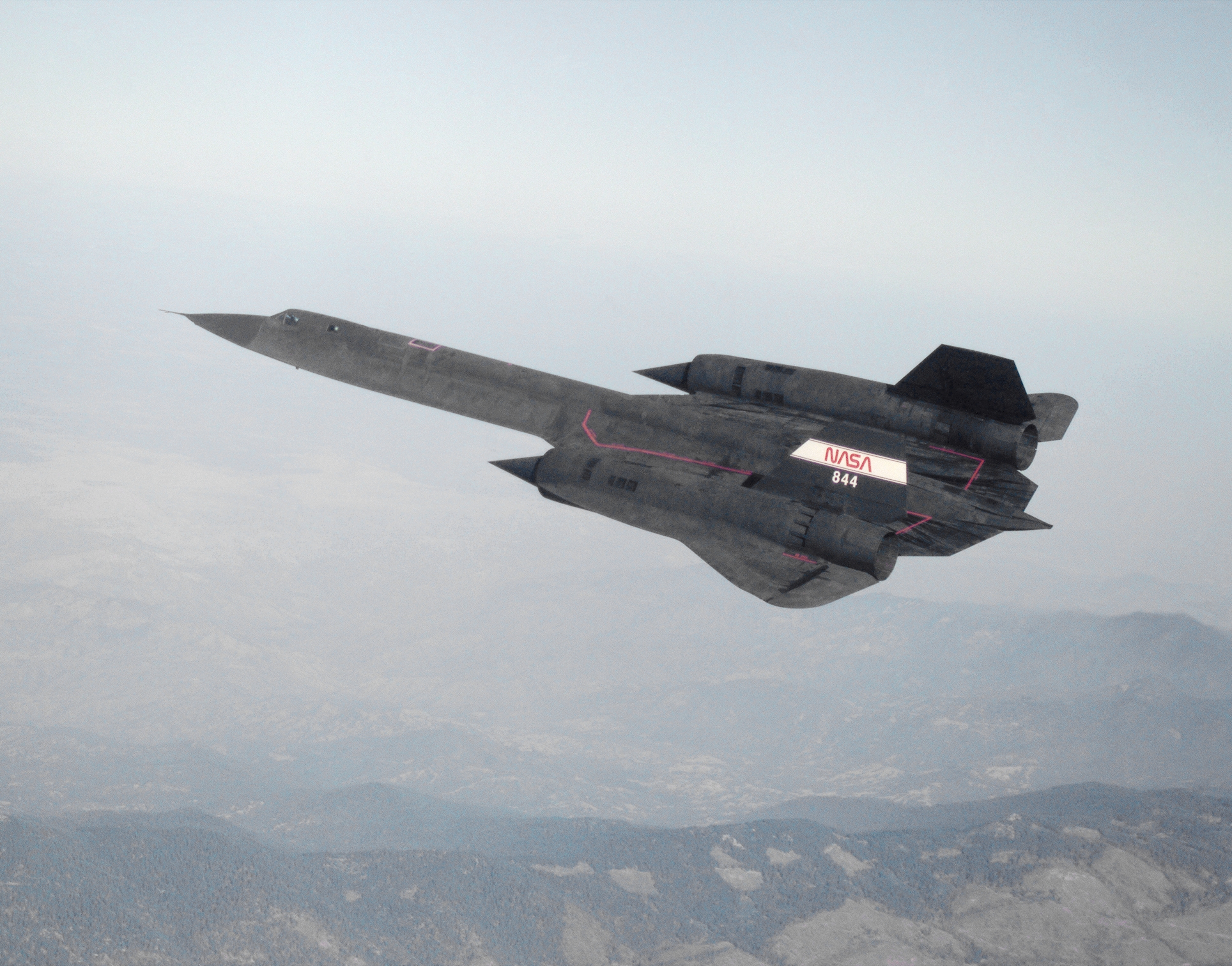

The first successful aircraft to deliberately use stealth principles (radar-absorbing coating, special shape) was the SR-71 Blackbird reconnaissance aircraft, developed by the Skunk Works group (a division of Lockheed Corporation). The first flight of the SR-71 took place on December 22, 1964 [5]. These technologies were then used to create the Lockheed F-117 Nighthawk fighter-bomber. whose first flight took place on June 18, 1981 [6].
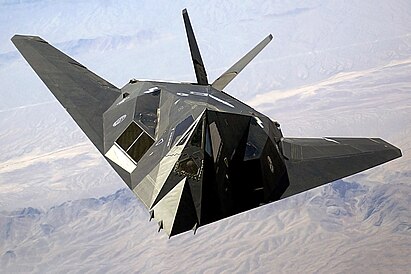 F-117 in flight. Photo source: Wikipedia

In the USSR in the 1960s, stealth technology was not involved. Only at the theoretical level in the closed Central Research Institute-108 did they study the interaction of electromagnetic waves with surfaces. These studies were carried out by a young theoretical physicist Pyotr Yakovlevich Ufimtsev. He published the results of his research in 1962 in a monograph [7], and in 1964 in the form of an article in the journal of the Moscow Institute of Radio Engineering [8]. These works were of a purely theoretical nature and contained a mathematical apparatus for calculating the interaction of radio waves with surfaces of different shapes.
In the Soviet Union, P. Ya. Ufimtsev’s research was considered unpromising. And in the USA they were not only noticed, but translated into English (in 1972), studied in detail and subsequently used for an algorithm for calculating wave dispersion when creating the F-117. This was openly stated by the head of Skunk Works Ben Rich [9] and Denis Overholzer [10] (an emigrant from the USSR) - an employee of Skunk Works, who, in fact, translated Ufimtsev’s work into English and then led the development of the wave scattering algorithm for the F-117.
Thanks to the high appreciation of his research in the USA, P.Ya. Ufimtsev has been a visiting professor at the University of California at Los Angeles since 1990 and has been collaborating with Northrop Grumman Corporation, one of the leading companies in the field of electronics and aerospace engineering [11-12].
Conclusion
Stealth technology was developed in the USA, not the USSR, although in developing this technology American engineers used the theoretical work of Soviet physicist Pyotr Yakovlevich Ufimtsev. In the USSR, P. Ya. Ufimtsev’s research was considered unpromising, while in the USA it was highly appreciated and secured him a job at a reputable state university and a leading industrial company.
Information sources
1. Invisible front. The world's first stealth aircraft were invented in the USSR. How did this technology change warfare? (in Russian) https://lenta.ru/articles/2022/10/12/stealth/
2. Stealth technology was invented by Pyotr Yakovlevich Ufimtsev. (in Russian) https://dzen.ru/a/YQi10b5Nbj1DGscd
3. Russian stealth. Who developed the stealth aircraft technology. (in Russian) https://topwar.ru/162805-russkij-stels-kto-razrabotal-tehnologiju-samoleta-nevidimki.html
4. Yu. Kuzhelev. "Stealth": the first five years. (in Russian) https://warspot.ru/12731-stels-pervye-pyat-letPublished August 22, 2018
5. Crickmore. Lockheed SR-71. Operations in Europe and the Middle East (Combat Aircraft). Osprey Publ. USA, 2009. – 96 p. (30-31)
6. C. Aronstein, A.C. Piccirillo Have Blue and the F-117A: Evolution of the "Stealth Fighter." American Institute of Aeronautics and Astronautics, Inc., 1997. https://doi.org/10.2514/4.86795
7. P. Ya. Ufimtsev. Edge wave method in the physical theory of diffraction. M.: Soviet radio, 1962. – 243 p. (in Russian)
8. B. Nemirovsky. How to miss the invisible. (in Russian) https://kackad.press/2023/02/16/how-to-miss-the-invisibility
9. B. Rich Leo Janos. Skunk Works: A Personal Memoir of My Years at Lockheed Little Brown & Co, 1994. - 370 p.
10. Ufimtsev’s question, or who stole the stealth? (in Russian) https://youroker.livejournal.com/101040.htm
11. Myths about stealth. Interesting stories. (in Russian) https://interesnye-istorii.in.ua/stealth-myph/
12. Ufimtsev Petr Yakovlevich. Material from Wikipedia.
Cover photo: The F-117A is the very first real Stealth. Source: Interesting Stories
.png) Dear reader, We invite you to share your opinion about this article and the Trust but Verify project in general through available communication channels. We will take your opinion into account when selecting content and verifying information. If your arguments are convincing, we are ready to make adjustments in evaluating statements, facts and conclusions
Dear reader, We invite you to share your opinion about this article and the Trust but Verify project in general through available communication channels. We will take your opinion into account when selecting content and verifying information. If your arguments are convincing, we are ready to make adjustments in evaluating statements, facts and conclusions