
Russian President V. Putin in an interview with T. Carlson 02/06/2024: “When the Soviet Union was formed, this is already 1922, the founder of the Soviet state, Lenin, for unknown reasons, endowed the emerging Soviet Ukraine with lands, people living in these territories, even if they had never before were not called Ukraine, for some reason during formation all this was “merged” into the Ukrainian SSR... Soviet Ukraine received a huge number of territories that never had anything to do with it, especially the Black Sea region."
.png)
The credibility of this statement was assessed by Mark Beygelzimer, PhD, systems analyst, head of the Trust but Verify project.
Facts
When concluding the agreement on the formation of the USSR, signed in December 1922, the principles of Ukrainian-Russian territorial demarcation were clearly defined. The main one was defined as “national-ethnographic”. That is, those regions where there were more Ukrainians than Russians were included in Ukraine.
This is confirmed by the 1926 census (see Fig. 1). Thus, the share of Ukrainians and Russians was:
- in the eastern districts of Ukraine bordering the Russian Federation - 70.1% Ukrainians and 24.4% Russians (including in the Kharkov district - 70.5% and 22.6%, Kupyansky - 83.7% and 15.8%, Starobelsky - 89.2% and 10.2%, Lugansk - 51.7% and 42.8%, Stalinsky - 56.5% and 31.4%);
- in the Azov region - 56.8% Ukrainians and 22.7% Russians (including in the Mariupol district - 54.9% and 18.5%, Melitopol - 57.8% and 25.1%);
- in the Black Sea region - 57.2% of Ukrainians and 18.4% of Russians (including in the Kherson district - 77.6% and 11.4%, Nikolaevsky - 61.2% and 17.7%, Odessa - 41.4% and 23.3%) [1].
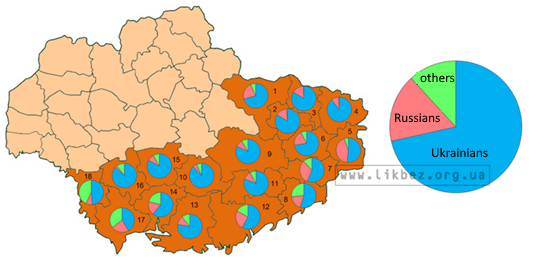
Figure 1. The share of Ukrainians, Russians and other nationalities in the southeastern districts of Ukraine according to the 1926 All-Union Population Census. Source: project LikWithout
Similar ratios have existed since the times of the Russian Empire, which was recorded in the 1897 census: in all provinces of the southeast, the Azov region and the Black Sea region, there were 2-4 times more native speakers of the Ukrainian language than Russian [2].
Therefore, after the revolution of 1917, all these lands were immediately included in two competing autonomous Ukrainian entities: the non-Soviet Ukrainian People's Republic (UNR) and the Ukrainian People's Republic of Soviets (Fig. 2) [3].
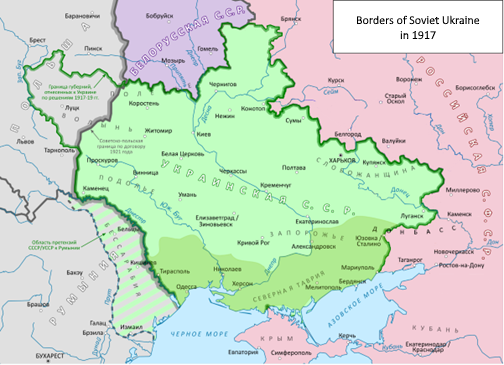
Figure 2. The borders of Soviet Ukraine, initially proclaimed in December 1917 as part of Soviet Russia, and in March 1919 transformed into the independent Ukrainian Socialist Soviet Republic. The Black Sea region along with the Azov region is highlighted with a darker green background. Adapted from [3].
Information sources
1. All-Union Population Census of 1926. – Volume XIII: Ukrainian Socialist Soviet Republic / Central Statistical Office of the USSR, Census Department. – M.: Publishing house of the Central Statistical Office of the USSR, 1929. – 472 p.
2. The first general census of the Russian Empire in 1897 / Ed. Center. Stat. committee of M-va ext. affairs; edited by N. A. Troinitsky. - [SPb.], 1897-1905.
3. Establishment of the borders of the Ukrainian Socialist Soviet Republic in 1917-1928https://commons.wikimedia.org/wiki/File:1917-1928_Soviet_Ukraine_borders_formation.svg

Verdict
 V. Putin’s statement that in 1922 the Russian-Ukrainian border was drawn unfairly is not true. In 1922, those southeastern regions where there were more Ukrainians were included in Ukraine. They were Ukrainian-speaking even in the Russian Empire, and since 1917 they were officially called “Ukraine”.
.png) Dear reader, We invite you to share your opinion about this article and the Trust but Verify project in general through available communication channels. We will take your opinion into account when selecting content and verifying information. If your arguments are convincing, we are ready to make adjustments in evaluating statements, facts and conclusions
Dear reader, We invite you to share your opinion about this article and the Trust but Verify project in general through available communication channels. We will take your opinion into account when selecting content and verifying information. If your arguments are convincing, we are ready to make adjustments in evaluating statements, facts and conclusions