
Russian President V.Putin said: "According to the results of 2022, Russia has become one of the five largest economies in the world and has overtaken the Federal Republic of Germany in purchasing power parity, in terms of economic volume" (at the Council for Strategic Development and National Projects on August 22, 2023);
"The largest number of sanctions that are applied in the world are applied against Russia. And we have become the first economy in Europe during this time" (in an interview with T. Carlson on February 6, 2024).
.png)
The credibility of this statement was assessed by Mark Beygelzimer, PhD, Systems Analyst, Project Manager for Trust but Verify.
Facts
V. Putin’s statement refers to the macroeconomic indicator “ Total GDP calculated at purchasing power parity ,” abbreviated as GDP PPP. According to the World Bank, Russia in this indicator in 2022 was ahead of Germany by 0.08% [1, as of 02/21/2024] (5326 versus 5323 billion USD).
However, in March 2024, the World Bank recalculated the GDP PPP indicator for 2018-2022, using the “current dollar” and harmonizing the data with the methodology of the International Monetary Fund (IMF) [2]. As a result, Russia dropped to second place, behind Germany (5082 versus 5582 billion USD) [1].
But this is not the main thing. The main thing is that GDP PPP is NOT an indicator that allows you to objectively compare the size of the economies of different countries. In other words, GDP PPP does not allow one to estimate the economic “weight” of a country in relation to other countries. This is due to the fact that PPP is a conditional (“parity”) exchange rate of a national currency, based on the cost of a standard set of goods and services in each individual country. The simplest and most understandable analogue of PPP is the Big Mac Index. For poor countries, the parity exchange rate of the national currency is more profitable than the market rate, so all macroeconomic indicators calculated using PPP look better.
The generally accepted indicator of the economic weight of different countries in the world is GDP, calculated not at “parity”, but at the market exchange rate of the national currency. According to this indicator, the Russian economy in 2022 ranked eighth in the world and fourth in Europe , behind Germany, Great Britain and France [1] (see figure).
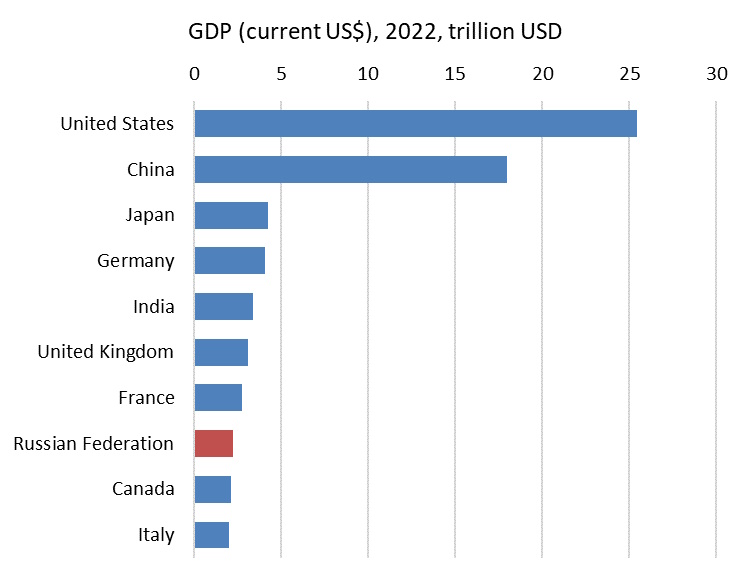 Top 10 countries with the largest economies in 2022 according to the World Bank
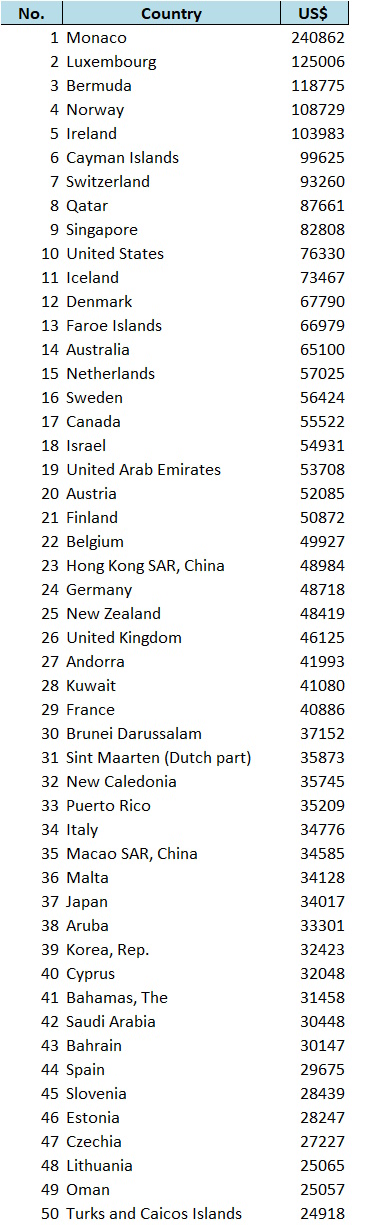
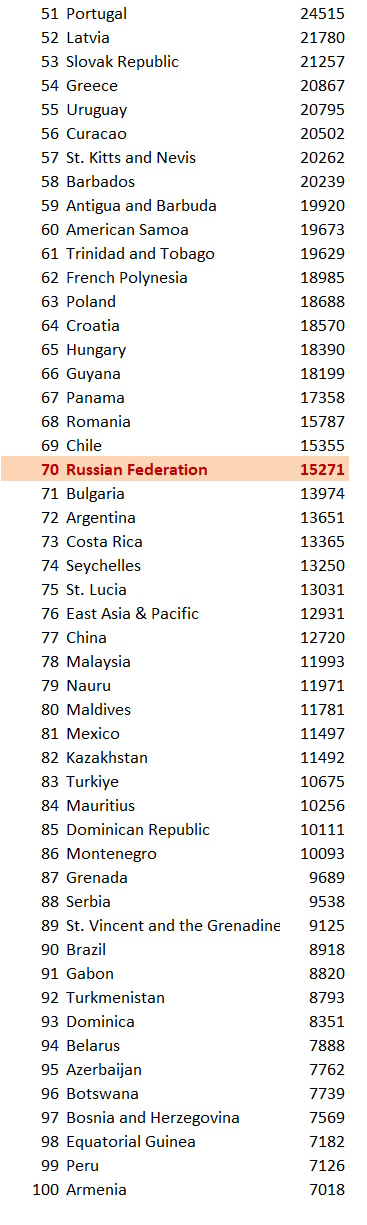
Why then is GDP PPP calculated? This indicator is used to compare the standard of living of citizens in different countries. But in this case it is divided by the number of inhabitants of the country, obtaining GDP PPP per capita . According to this indicator, in 2022 Russia was 34th in Europe and 70th in the world [1] (see table).
World Bank data on PPP (GDP) per capita in current dollars for 2022
Information sources
1. World Bank. World Development Indicators Database. The World Bank. DataBank. World Development Indicators.https://databank.worldbank.org/source/world-development-indicators#
2. International Monetary Fund. World Economic Outlook Database. International Monetary Fund. World Economic Outlook Database. https://www.imf.org/en/Publications/WEO/weo-database/2023/October/download-entire-database
Verdict
.jpg) V. Putin’s statement that Russia in 2022 became the first economy in Europe and the fifth in the world is manipulation . The macroeconomic indicator that Putin refers to is not used either to compare the size of the economies of different countries, or to assess the standard of living of their citizens. In fact, in 2022, in terms of economic size, Russia was fourth in Europe and eighth in the world, and in terms of living standards it ranked 34th in Europe and 70th in the world.
V. Putin’s statement that Russia in 2022 became the first economy in Europe and the fifth in the world is manipulation . The macroeconomic indicator that Putin refers to is not used either to compare the size of the economies of different countries, or to assess the standard of living of their citizens. In fact, in 2022, in terms of economic size, Russia was fourth in Europe and eighth in the world, and in terms of living standards it ranked 34th in Europe and 70th in the world.
The image on the cover is a frame from a video interview with Vladimir Putin.
.png) Dear reader, We invite you to share your opinion about this article and the Trust but Verify project in general through available communication channels. We will take your opinion into account when selecting content and verifying information. If your arguments are convincing, we are ready to make adjustments in evaluating statements, facts and conclusions
Dear reader, We invite you to share your opinion about this article and the Trust but Verify project in general through available communication channels. We will take your opinion into account when selecting content and verifying information. If your arguments are convincing, we are ready to make adjustments in evaluating statements, facts and conclusions