
It is hard to find another technical invention, around whose authorship there would be so many disputes as around radio. Each country defends the priority of its inventors: in Russia - A. Popov [1], in India - D.-C. Bose [2], in England - O. Lodge [3] and G. Marconi [4]. Bose [2], in England - O. Lodge [3] and G. Marconi [4], in Italy - G. Marconi [5], in Germany - H. Hertz [6], in the USA - D. Hughes [7] and N. Tesla [8], in the Balkan countries - N. Tesla [9], in France - E. Branly [10], in Brazil - Landell de Moro [11].
However, from this list, still stand out 4 people whose services are recognized worldwide: Heinrich Hertz, Nikola Tesla, Alexander Popov and Guglielmo Marconi.
.png)
Mark Beygelzimer, PhD, systems analyst, head of the Trust but Verify project.
Reference:
Hertz, Heinrich Rudolf (February 22, 1857 - January 1, 1894) was a German physicist and a prominent experimentalist. He graduated from the University of Berlin. In different years he was a professor of physics at the universities of Karlsruhe and Bonn (Germany).
Tesla, Nikola (July 10, 1856 - January 7, 1943) was a Serbian-born physicist, engineer and inventor. Born in the Austrian Empire, he grew up in Austria-Hungary. He studied at the Higher Technical School in Graz, where he studied electrical engineering. Worked in France and the United States. In 1891 he became a U.S. citizen.
Popov, Alexander Stepanovich (March 4 (16), 1859 - December 31, 1906 (January 13, 1907)) - Russian physicist and engineer. He graduated from St. Petersburg University. He worked in Kronstadt as a physics teacher, then in St. Petersburg as a professor of physics at the Electrotechnical Institute of Emperor Alexander III.
Marconi, Guglielmo Giovanni Maria (April 25, 1874 - July 20, 1937) was an Italian engineer and entrepreneur. He studied science at schools in Britain and Italy, and attended physics classes at the University of Bologna, although he received no formal higher education. Never a salaried employee, he worked independently, developing his own business in radio engineering. Winner of the 1909 Nobel Prize in Physics with Karl Ferdinand Braun “in recognition of their contribution to the development of wireless telegraphy”.
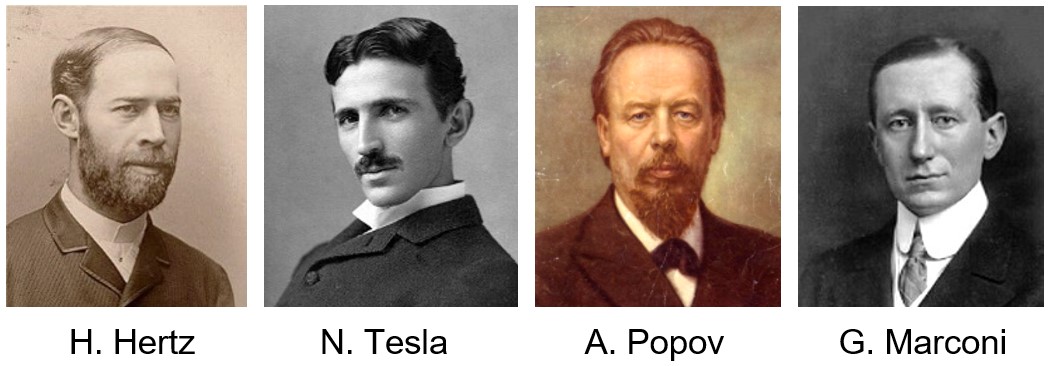
Which of the big four should be given the laurels of primacy in the invention of radio? Let's try to understand and dot all the i's.
For this purpose, we will use the globally accepted classification of stages of technical innovation development. These stages are known as TRL - Technology Readiness Level. According to this classification, nine stages can be distinguished in the process of development of any technical innovation [ref]:
TRL 1 — an idea is proposed,
TRL 2 — conceptual solutions to implement the idea are developed,
TRL 3 — the reality and usefulness of the idea is confirmed experimentally or by calculations,
TRL 4 — conceptual solutions are tested in laboratory conditions,
TRL 5 — a pilot prototype is created,
---------------------------------------
TRL 6 — a pilot-industrial prototype is created,
TRL 7 — a pilot-industrial prototype is used in practice,
TRL 8 — an industrial unit is created,
TRL 9 — an industrial unit is operated in practice in normal mode.
The line between TRL 5 and TRL 6 can be called the “socially relevant frontier”. At all stages before this boundary (i.e. before TRL 5), a technical invention is of interest only to its author and a narrow circle of persons associated with it. The stages after this boundary (from TRL 6 onwards) have a practical impact on a wide audience, up to the whole of humanity.
Facts
The table below summarizes, in chronological order, the key events in the activities of each of the four radio developers listed. The events are numbered and briefly described below the table. Each event is categorized to one or another level of TRL. Events of different TRL levels are indicated by different background colors. The numbering of each event consists of two basic symbols: a letter corresponding to the researcher's surname and a number corresponding to the TRL level number. If several events correspond to one TRL level, an additional ordinal number in brackets is entered. For example, G-3 is a TRL level 3 event associated with Hertz, M-5 (2) is the second of the TRL level 5 events associated with Marconi.
_en.jpg)
Description of events
Hertz
Г-2. In 1886, Heinrich Hertz completes an experimental setup to test Maxwell's theory of electromagnetic waves [12].
Г-3. In 1887, Hertz conducts his first successful experiments [13], which confirmed the existence of electromagnetic waves predicted by Maxwell.
Г-4. In 1888, on the basis of his 1887 experiments, Hertz publishes a fundamental work “On Electrodynamic Waves in Air and Their Reflection” [14] describing the conceptualization of electromagnetic waves in the air and their reflection [14] describing the conceptual elements (transmitter, receiver, etc.) that his followers then used in radio engineering systems.
Tesla
Т-2. In 1891, Nikola Tesla publicly described the principles of long-distance signal transmission in his lectures in St. Louis, Missouri (USA) [15]. In the same year, he issued US patent No. 454622 for a device for producing electromagnetic oscillations with a resonance transformer [16].
Т-3. In 1893, Tesla demonstrates at the Franklin Institute in Philadelphia a device based on the patent he received in 1891 (see T-2) [16].
Т-4. In 1893, Tesla invents a mast antenna with which he would later, in 1986, transmit radio signals over 30 km for the first time [15].
Т-6. In 1896, near New York City, Tesla built a radio station that transmitted signals over 32 kilometers. He increased the current frequency to 2 megahertz, which was previously unattainable. The signals were received on ships moving along the Hudson River at a distance of more than 25 kilometers [17, p. 130].
Popov
П-3. On May 7 (April 25, old style), 1895, A.S. Popov demonstrated at St. Petersburg University a device capable of transmitting signals over a distance [18].
П-4. In May 1895, the device that Popov had demonstrated a little earlier at St. Petersburg University (see P-3) was adapted to capture thunderstorm electromagnetic waves at the weather station of the Forest Institute [19, p. 66].
П-5 (1). On April 2, 1896, experiments with a device made according to a slightly modified Popov's scheme were demonstrated at the Electrotechnical Institute, in which the signal reception from a Hertz vibrator from another building was carried out at a distance of 40 m [19, p. 67].
П-5 (2). On December 18, 1897, at a meeting of the Russian Physical and Chemical Society, using Hertz's vibrator and a receiver of his own design, A. Popov transmitted a radiogram at a distance of 230 m consisting of two words: “Heinrich Hertz” [20, p. 147] [20, p. 147] (in many publications the date of transmission of this radiogram is erroneously [21] indicated as March 12, 1896).
П-6 (1). In 1897-1899, when Popov supervised tests of wireless telegraph stations, communication between two warships was achieved at a range of about 5 km [29].
П-6 (2). In early 1899, the French entrepreneur E. Ducreté began small-scale production of receivers of the A. Popov system [21].
П-6 (3). The crew of the battleship “General-Admiral Apraksin”, which ran aground and was wiped out by ice in the Gulf of Finland, managed to use A. Popov's radiotelegraph stations to contact the ground and transmit data about the accident. During three months of ice captivity the crew of the battleship transmitted more than 400 radiograms [22][29].
Marconi
М-4. On June 2, 1896, Guglielmo Marconi applied for UK patent No. 12039 “Improvements in the transmission of electrical impulses and signals and in apparatus for the same” (the patent was granted on July 2, 1897) [19, pp. 79, 82], [16].
М-5 (1). In July 1896, Marconi demonstrated his apparatus by transmitting a signal from the roof of the London Post Office to another building at a distance of 400 meters [23].
М-5 (2). On September 2, 1896, Marconi gave the first public demonstration of his apparatus on Salisbury Plain. The communication range was 2.5 km [23].
М-5 (3). In May 1897, Marconi realized the transmission of telegraph signals (words and phrases) across Bristol Bay to a distance of 14 km [23].
М-6 (1). July 6, 1897 Marconi transmits the phrase “Viva l'Italia” from behind the horizon line at the Italian naval base of La Spezia - at a distance of 18 km [24].
М-6 (2). In November 1897, Marconi's first stationary radio station was built on the Isle of Wight, which in early 1898 provided communication between the island and the mainland at a distance of 23 km [19, p. 90].
М-7 (1). January 1898. First practical use of radio: during a snowstorm that felled telegraph poles, Marconi transmits reports from journalists in Wales about the fatal illness of former British Prime Minister William Gladstone [25][15].
М-7 (2). In May 1898, Marconi pioneers a system of tuning the receiver to the frequency of the transmitting station. In 1900, Marconi receives patent #7777 in the UK for the “Oscillating Sintonic Circuit” [15][28].
М-8 (1). In late 1898, Marconi opens Britain's first “wireless telegraph factory” in Chelmsford, England, employing 50 people [15][16][26][27].
М-8 (2). In December 1901, Marconi conducted the first radio communication session across the Atlantic Ocean, linking the US and Britain over a distance of 3,200 km [15].
М-9. In 1907, Marconi established the first permanent transatlantic wireless telegraph line from Clifden, Ireland, to Glace Bay, Nova Scotia, Canada, a distance of over 3000 km [16].
Analysis of the table
The above table shows that:
• Hertz was the first to experimentally confirm the reality of radio communication and tested it in laboratory conditions (TRL 2, 3 and 4).
• Popov was the first to build a prototype (TRL 5).
• Tesla was the first to build a prototype (TRL 6).
• Marconi was the first to develop it into an industrial unit and put it into full-scale operation (TRL 7, 8 and 9).
Additional Facts
Heinrich Hertz tried to disprove Maxwell's theory of electromagnetic wave propagation with his experiments. However, having obtained the opposite result, he recognized his mistake. However, even after that he did not see any prospects for using the effect he had discovered. When the scientist was asked how his discovery could be used in practice, he replied: “I suppose there is no way” [ref].
In 1897, Alexander Popov appealed to the Russian Minister of Marine (or, more precisely, at that time, to F.K. Avelan, the acting manager of the Maritime Ministry) with a request to allocate a thousand rubles to the physics room of the Mining Class for the purchase of new devices. In his report Popov wrote that he needed the devices to further improve the telegraph without wires. But it's not so easy to get the Naval Minister Avelan. The Minister is not some ignoramus: he knows perfectly well that the most important thing in any telegraph - poles and wires. The minister's resolution reads: “I do not authorize to release funds for such a chimera.” Alexander Popov was left without money and did not get an opportunity to develop his ideas to a practically significant application [ref].
In 1896, Marconi moved to London with a suitcase full of equipment and drawings, showed his know-how to the Ministry of Posts and Telegraphs and received full approval and material support for his research. “The British Ministry of Posts and Telegraphs will stop at no expense to carry out Mr. Marconi's plan,” said engineer William Preece and personally undertook to assist the Italian in his experiments [ref].
A.S. Popov was the first elected director of the Emperor Alexander III Electrotechnical Institute in St. Petersburg. On December 28, 1905 (old style) he was summoned to the Ministry of Internal Affairs, where, as director of the Institute, he was required to “take measures” against the youth protesting against the government's actions. A.S. Popov returned home extremely upset and died on December 31 after a short period of indisposition [#_nn1">ref].
Virtually all radio-frequented ships of the early 20th century (including the famous Titanic) had Marconi radios. It was the radio broadcasting corporation URI (Unione Radiofonica Italiana), founded with his participation, that on October 24, 1924, conducted the first broadcast in Europe, transmitting Haydn's quartet on the radio. Thanks to Marconi, transatlantic radio communication was established [#_n1">ref].
Matvey Bronstein, a young Soviet physicist and popularizer of science, wrote the manuscript of the book “Inventors of the Radio Telegraph” in 1935. In it, he explained in detail and honestly that the credit for the invention of radio belongs not only to A.S. Popov, but also to other researchers, including Guglielmo Marconi. “Popov knew nothing about Marconi, Marconi knew nothing about Popov, but both of them - the Russian professor and the Italian student - at the same time by the same method solved the same problem” - wrote Matvey Bronstein in his book. He described the first experiments with the radiotelegraph in all technical details and did not hide how lucky he was to have Marconi's support and how difficult it was for Popov to promote the idea of the radiotelegraph in Russia.
The manuscript “Inventors of the Radio Telegraph” was not allowed for publication. The editor-in-chief demanded that the author completely rework the book, pointing out that Marconi had stolen his invention from Popov (allegedly “with the help of Catholic monks”) and that it was Russia that had the priority of the discovery. Matvey Bronstein refused to remake anything and explained once again that radio was discovered simultaneously in different countries. But reasonable arguments did not work. “If even Marconi made his discovery independently, you, Comrade Bronstein, as a Soviet patriot, are obliged to insist on Popov's priority,” the editor told the physicist. Soon Matvey Bronstein was arrested and shot. He was in his 32nd year. Even personal petitions in defense from Kornei Chukovsky, Samuil Marshak, and Lev Landau did not help [ref].
Conclusion
There is simply no unambiguous answer to the question of who invented radio - Hertz, Tesla, Popov or Marconi - as each of them has priority at a certain stage in the development of radio communication.
There is no point in searching for plagiarism, because the birth of radio engineering is a classic example of an “explosion of technical solutions” caused by a new productive theory (in this case, Maxwell's theory). During such an “explosion” many researchers in different parts of the world independently of each other and almost simultaneously can find similar technical solutions. Besides, in conditions of open information (and the main information about the works of Hertz, Tesla, Popov and Marconi was open) mutual borrowing is simply inevitable.
The other thing that matters here is this. Hertz, not having lived to be 37, did not physically have time to do more than he did. Tesla quickly overcame all the stages of readiness of radio communication technology to the prototype (TRL 6), but then focused on a more important (as he understood) task: the transmission over a distance not of radio signals, but of electricity. Marconi saw great commercial potential in radio engineering, primarily for civilian applications, and he was well supported in Britain, ensuring that his designs progressed steadily from the laboratory to the industrial model (i.e., from TRL 4 to TRL 9). Popov is the only one among the four who was not allowed to cross the “socially significant boundary” between the prototype (TRL 5) and the industrial prototype (TRL 6) in time. People who had power and money in the Russian Empire did not appreciate in time the prospects of his invention for the military sphere (in particular, for the Imperial Navy), and the usefulness of radio communication for the civilian population in Russia was simply not discussed.
Therefore, not from the position of priority, but from the point of view of the practical value of the invention of radio communication for all human civilization, the laurels of primacy should be given to Marconi.
References
1. Aleksandr Popov. Britannica
2. Jagadish Chandra Bose: The Real Inventor of Marconi’s Wireless Receiver. Archived copy dated June 16, 2015 at the Wayback Machine; Varun Aggarwal, NSIT, Delhi, India
3. Sir Oliver Joseph Lodge. Britannica
4. Guglielmo Marconi. Britannica
5. Guglielmo Marconi, l’inventore che ha scoperto la radio: la biografia. Geopop. 2 Maggio 2024.
6. Heinrich Hertz: Der Urvater des Radios. Spiegel. 22.02.2012.
7. History of Wireless: David E. Hughes. Ezurio. Published on February 22, 2013.
8. Louis E. Frenzel. Tesla Invented Radio, Not Marconi! Tesla Universe. Nuts and Volts. February, 2007. 88-89.
9. Robert Bubalo. Tesla was credited with the invention of radio after his death, although Marconi won the Nobel. Vecernij list. 21.02.2020.
10. TSF : Livres anciens, rares, d’occasion sur Galaxidion Архивная копия от 29 ноября 2011 на Wayback Machine (фр.)
11. Landell de Moura, o inventor do rádio. Historia do mundo.
12. I. G. Klatskin. Heinrich Hertz and modern radio engineering. In the book “50 Years of Hertz Waves”. Publ. AS USSR. Moscow, Leningrad: 1938. 31-44.
13. H. Hertz. On very rapid electric oscillations. In the book “50 Years of Hertz Waves”. Publ. AS USSR. Moscow, Leningrad: 1938. 45-75.
14. H. Hertz. On electrodynamic waves in air and their reflection. In the book “50 Years of Hertz Waves”. Publ. AS USSR. Moscow, Leningrad: 1938. 76-91.
15. Radio. Material from Wikipedia.
16. Radio Chronology. Material from Wikipedia.
17. B. N. Rzhonsnitsky. Nikola Tesla. - Moscow: “Molodaya Gvardiya”. 1959. 229 p.
18. On May 7, 1895, Russian inventor Alexander Stepanovich Popov demonstrated a device for detecting an approaching thunderstorm, the “thunderstorm meter”. #:~:text=25%20апреля%20(7%20мая)%201895,приближающейся%20грозы%20–%20«грозоотметчика».">Communication technology.
19. V. I. Shapkin. Radio: discovery and invention. Science. Technics. Sotsium. - Moscow: DMK Press, 2005. - 190 p.
20. The invention of radio. A. S. Popov. Documents and materials / Compilers: E. A. Popova-Kyandskaya, V. M. Rodionov, M. I. Mosin, V. I. Shamshur. Edited by A. I. Berg. Moscow: Nauka, 1966. 284 с.
21. Popov, Alexander Stepanovich. Material from Wikipedia.
22. Rescue of the battleship “General-Admiral Apraksin”. Museum of the Russian Navy. 10.04.2017.
23. V. Merkulov. What kind of radio did Marconi invent. www.computer-museum.ru. Date of circulation: September 1, 2022. Archived May 8, 2020.
24. V. Merkulov. When and by whom radio was invented. Virtual computer museum. Date of access: April 16, 2013. Archived May 10, 2013.
25. Hermeet Gill. Marconi: Between Earth & Air. Distance.
26. Маркони, Гульельмо. Материал из Википедии. Marconi, Guglielmo. Material from Wikipedia.
27. Gugilelmo Marconi. SimplyKnowledge.
28. History in names: Radio communication as such. A portal for radio amateurs.
29. Prerequisites for the emergence, development and combat application of forces and means of marine RER in the Russian Imperial Navy 1895-1917.
.png) Dear reader, We invite you to share your opinion about this article and the Trust but Verify project in general through available communication channels. We will take your opinion into account when selecting content and verifying information. If your arguments are convincing, we are ready to make adjustments in evaluating statements, facts and conclusions
Dear reader, We invite you to share your opinion about this article and the Trust but Verify project in general through available communication channels. We will take your opinion into account when selecting content and verifying information. If your arguments are convincing, we are ready to make adjustments in evaluating statements, facts and conclusions